North Node
The North Node is the ascending lunar node: the south-to-north crossing of the ecliptic in the Moon’s orbital geometry.
Read the entry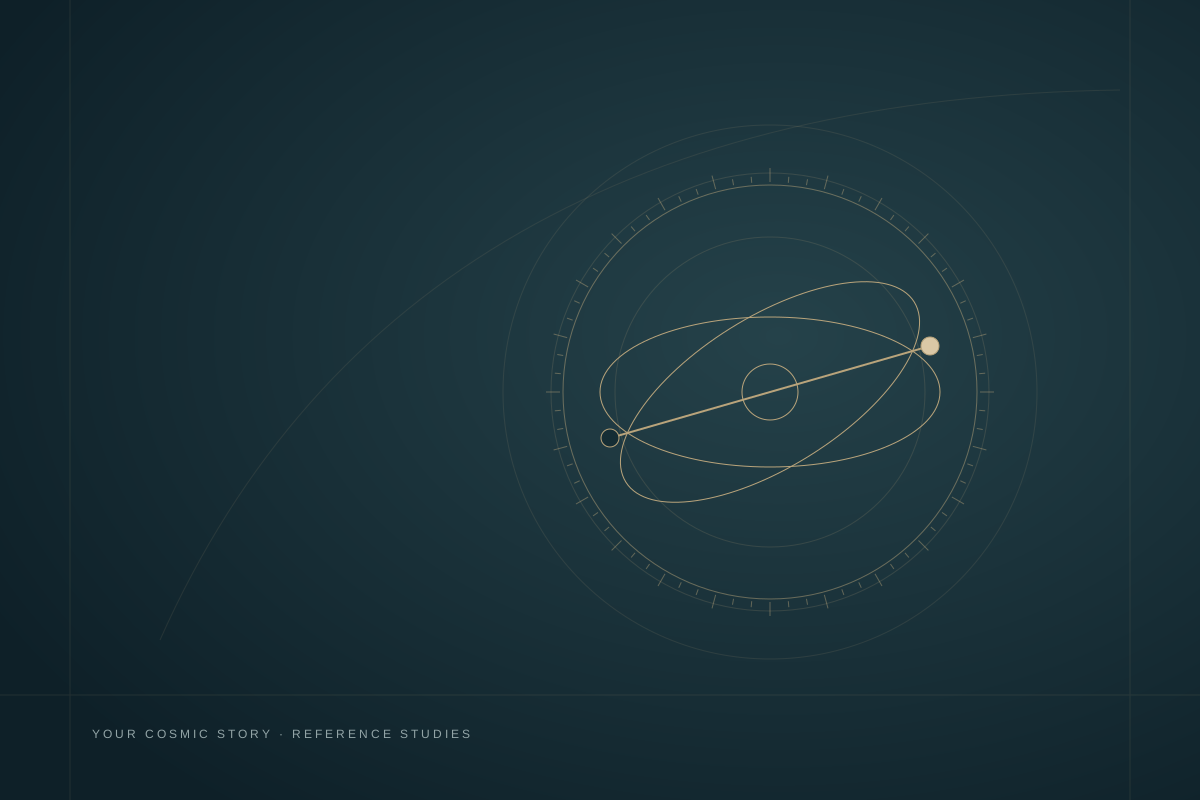
THE OBSERVATORY · EXPLORE
Explore the Moon’s nodes through three illustrated references: North Node, South Node and nodal-axis geometry. Compare interpretations and node models.
TWO POINTS · THREE WAYS IN
Start with a point, or understand the line that connects the pair. The individual entries introduce selected symbolic approaches; the axis article explains the coordinates, model choices and eclipse connection.
The North Node is the ascending lunar node: the south-to-north crossing of the ecliptic in the Moon’s orbital geometry.
Read the entryThe South Node is the descending lunar node: the north-to-south crossing of the ecliptic in the Moon’s orbital geometry.
Read the entryThe lunar nodal axis joins the North and South Nodes.
Read the entryThe lunar nodes are the paired ascending and descending points in lunar orbital geometry. A chart can represent them through a mean or an osculating node model. The term refers to calculated points rather than additional moons or planets.
The Moon, its Moon sign and a lunar node answer different questions. A Moon sign labels the body’s zodiac position. A node labels an orbital crossing. Knowing one does not supply the other.
Read the geometric explanation first if you are comparing two charts. Read the individual entries first if a report’s language is what brought you here. Both routes lead back to the same definitions.
CHANI explicitly uses increase and release as a paired vocabulary. Dreyer and Brennan discuss other approaches, including modern development narratives and multiple Indian lineages. Rahu and Ketu identify the North and South Nodes in that discussion, but a shared point does not imply a shared interpretive system.
Our practical exercises use a limited selection of themes. They do not rank traditions, diagnose a person or claim to recover a past life. When following a source, keep its author, method and intended use attached to the interpretation.
Useful questions for any reading are concrete: Which point is being discussed? What are its coordinates? Which settings produced them? What tradition supplies the meaning? What can I assess from my own experience?
Keep a note of the date and time, zodiac, node model and any house convention. If a sign changes, compare the numerical coordinates before treating the two labels as a deep contradiction. The boundary example shows how a small difference can cross a sign division.
For related foundations, read zodiac reference frames, birth-time uncertainty and the aspect reference. The A–Z glossary provides short definitions and aliases.
Section 4.4 supports the crossing definitions and mean inclination. The fixed circular diagram is our own teaching model.
Sections 2.2.1–2.2.2 describe mean and osculating nodes. This citation documents terminology; it does not identify this site’s calculation engine.
Cited for CHANI’s own symbolic approach, not for eclipse limits, dates or orbital calculations.
An original practitioner discussion of naming and different lineages; not a universal interpretation or scientific validation.
The individual entries include sources for each topic. Our diagrams are original, explicitly defined teaching models, not images of a calculated personal sky.