Conjunction
A conjunction is an aspect centred on 0° of separation in ecliptic longitude.
Read the entry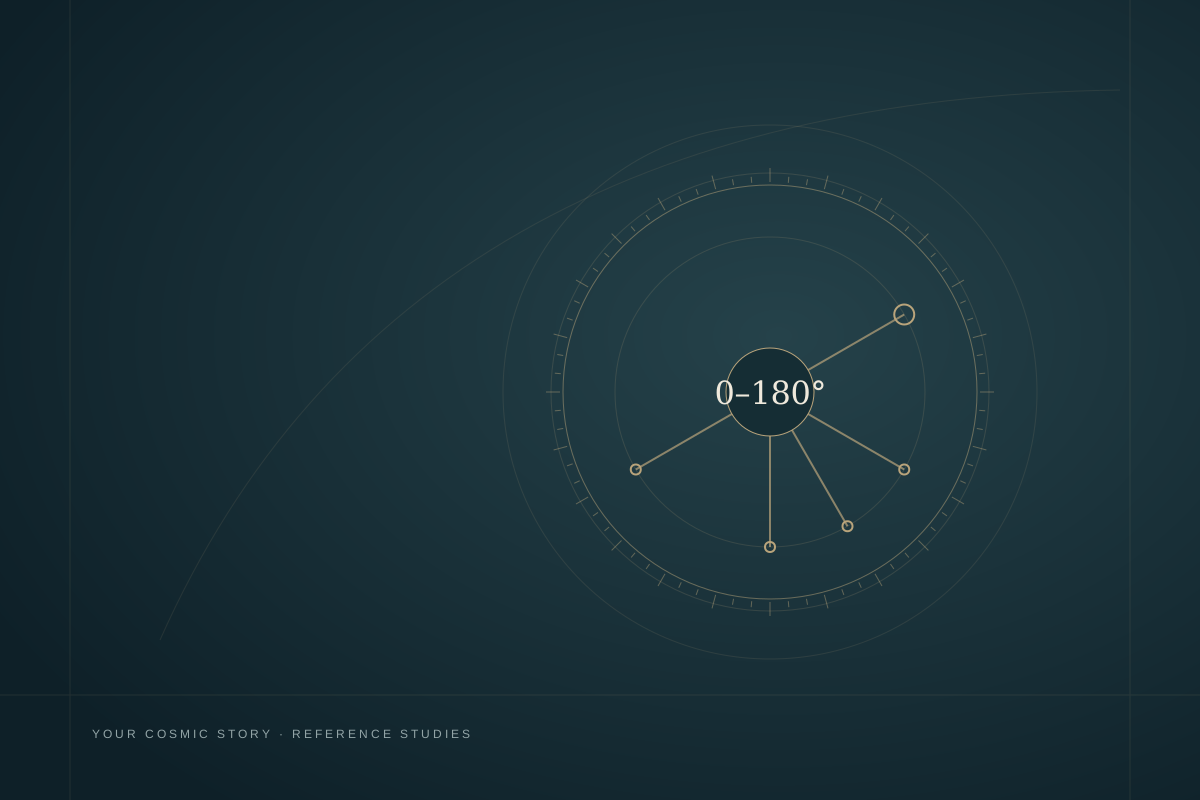
THE OBSERVATORY · EXPLORE
Compare conjunctions, sextiles, squares, trines and oppositions. Explore exact angles, worked examples, orbs and the difference between degrees and whole signs.
THE RELATIONSHIPS IN A CHART
An aspect names a relationship between chart positions. This reference compares the five major aspects using differences in ecliptic longitude. Each entry has its own example, diagram and reading context.
New to aspects? Start with the step-by-step guide →A conjunction is an aspect centred on 0° of separation in ecliptic longitude.
Read the entryA sextile is an aspect centred on a 60° difference in ecliptic longitude.
Read the entryA square is an aspect centred on a 90° difference in ecliptic longitude.
Read the entryA trine is an aspect centred on a 120° difference in ecliptic longitude.
Read the entryAn opposition is an aspect centred on a 180° difference in ecliptic longitude.
Read the entry| Aspect | Exact angle | Our reflection prompt |
|---|---|---|
| Conjunction | 0° | Bringing themes together |
| Sextile | 60° | Exploring cooperation |
| Square | 90° | Making room for adjustment |
| Trine | 120° | Noticing what feels familiar |
| Opposition | 180° | Considering both perspectives |
The angles are measurements. The prompts are ways to explore a symbolic vocabulary; they are not measured personality traits. Follow an entry for the distinction between its calculation and interpretation.
Convert both positions to longitudes on the same 0–360° circle. Find their absolute difference, then choose the smaller of that number and 360° minus that number. The result is between 0° and 180°.
Difference = |longitude B − longitude A|
Separation = min(difference, 360° − difference)
Orb from target = |separation − target angle|
For example, 358° and 176° have a raw difference of 182°, a shorter separation of 178°, and a 2° deviation from an opposition. The opposition diagram shows those invented positions.
Longitude is only one sky coordinate. The full angular distance also depends on latitude, as follows from the US Naval Observatory’s coordinate definitions. This reference measures longitude relationships; see the conjunction example for why that matters.
Here, “orb” names the deviation from the target angle; “allowed orb” names the tolerance used to include an aspect. A 62° separation is 2° from a sextile. With an inclusive 3° allowance it qualifies; with 1° it does not. Two reports can therefore disagree even if their positions match.
There is no single allowance used by every astrological tradition. Houlding describes planet-based orb systems and different historical approaches. Our examples state their allowances for reproducibility, not as recommended settings. For motion towards or away from exactness, continue to the guide’s applying and separating explanation.
A whole-sign relationship uses the signs occupied. A degree-based relationship uses the positions and a stated tolerance. At 29° Aries and 1° Taurus, the positions are in different signs but only 2° apart. At 29° Aries and 1° Virgo, they are 122° apart despite belonging to different elements. The conjunction and trine entries work through these examples.
Houlding discusses the distinction and historical disagreements. Ptolemy’s configuration chapter in the Ashmand / Proclus edition discusses the 60°, 90°, 120° and 180° relations between signs. It is historical context, not a source for a modern five-aspect list or universal orb settings.
Keep the chosen convention visible. For a chart reading, also identify the planets or points, the chart context and any missing birth information before moving from a number to an interpretation.
The Ptolemy link is the Foulsham 1900 edition of J. M. Ashmand’s translation from the Proclus paraphrase; the relevant chapter is Book I, XVI, pages 24–26. The individual entries identify their modern interpretive source. Numerical examples and diagrams are worked examples.
For our broader evidence standards, see our approach. For quick terminology, use the A–Z glossary.