The short answer
A transit chart represents planetary positions for a selected moment. When compared with a natal chart, the transit positions change with the selected date while the recorded natal positions remain the reference.
What stays fixed, and what moves?
Begin with the labels. A natal chart records a birth moment under a chosen set of calculation conventions. A transit layer supplies positions for another moment. CHANI describes this as a fixed natal snapshot alongside a changing sky. Changing the transit date does not rewrite the original birth positions.
A two-ring display is one way to make that comparison visible. Do not assume that its outer ring is always the transit layer: read the legend. A report may also show a table, two separate wheels or a single position list. The question is which time each set of coordinates belongs to.
Follow one invented comparison
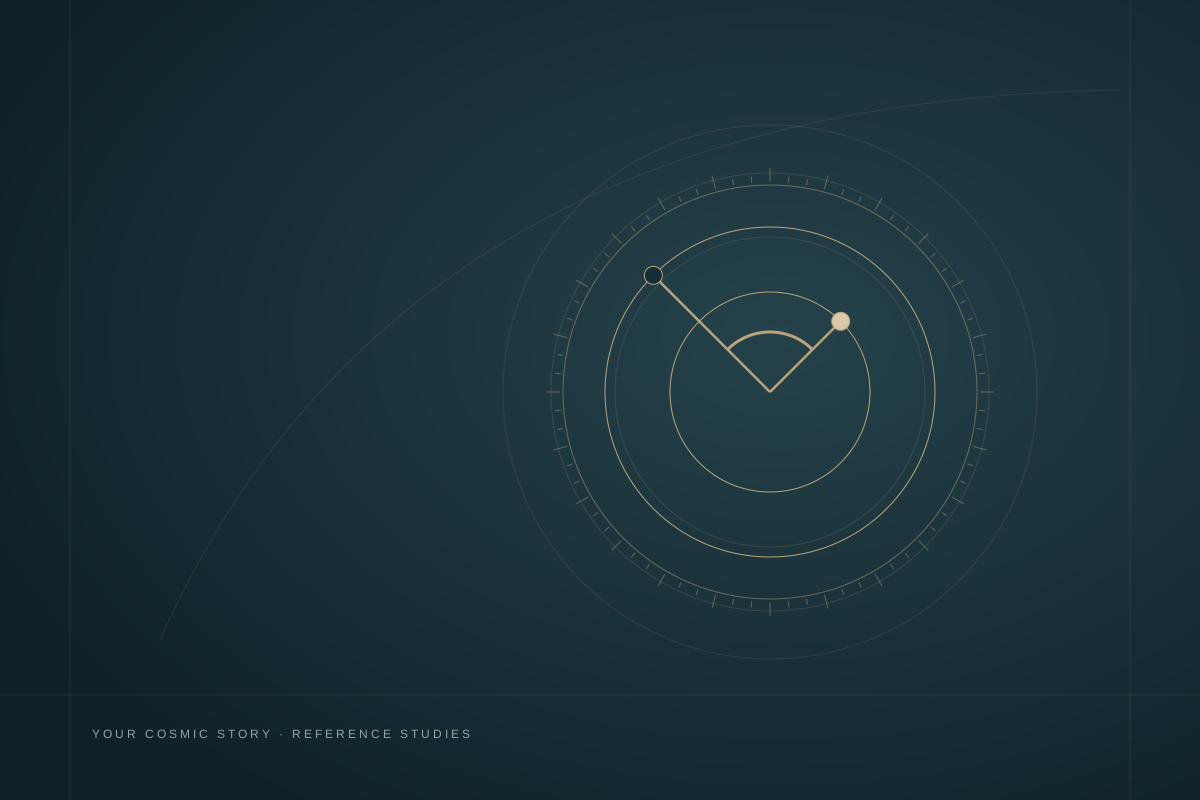
In our diagram, the natal position is 45°, or 15° Taurus, and the later position is 135°, or 15° Leo. Their difference is 90°. The rings separate the two sets of data; they do not represent distance from Earth. No planet, birth date or real transit date is assigned to these coordinates.
Now imagine changing only the transit position to 136°. The natal point stays at 45°, and the separation becomes 91°. That is one degree from an exact square. This small change is enough to alter the aspect’s numerical description without altering the birth chart itself. The transit-aspect article develops that comparison.
Natal, transit-to-natal and sky-to-sky aspects
Three statements can look similar in a report. A natal aspect compares two birth positions. A transit-to-natal aspect compares a selected sky position with a fixed birth position. An aspect between two transiting planets compares two positions that both belong to the later sky.
Write the labels out: “transiting A square natal B” carries more information than “A square B.” If both points move, their relative motion matters. If one point is natal, its recorded coordinate stays fixed in this comparison. A general sky forecast and a personal transit list therefore answer different questions.
Record the settings before interpreting
Keep the birth date, reported birth time and birthplace with the natal record. Record the transit date and time, including the time zone used to display it. Compare like coordinate conventions: the zodiac, any sidereal reference, the observer convention and the aspect settings.
An ephemeris is a source of positions for specified times. The Swiss Ephemeris documentation distinguishes time scales, coordinate choices and longitude speed. These distinctions explain why two unlabeled numbers are insufficient for a careful comparison. They do not mean you need to program an ephemeris to read a chart: start by checking the settings supplied by the chart’s provider.
Houses and angles need their own context
“A planet transiting my fourth house” is different from “a planet aspecting my natal Moon.” The first statement depends on the natal house boundaries used in that reading; the second compares the two stated positions. A chart cast for the transit moment can also have its own houses, which should not be confused with the natal houses.
If the birth time is uncertain, keep that uncertainty attached to angle and house claims. Do not make an exact claim about a transit to the Ascendant from an assumed birth time. The birth-time guide explains what remains uncertain, and the angle reference introduces the points involved.
A practical way to annotate a report
Choose one line and make three notes: the two positions being compared, the date and settings that produced them, and the interpretation the author attaches to the comparison. This keeps a coordinate statement separate from a symbolic claim.
For an original practice exercise, imagine a report prompts you to reconsider your weekly workload. List one concrete responsibility you can change and one you cannot. Review the actual result later, including anything that did not fit the interpretation. The chart can supply a question; your circumstances and evidence supply the answer.
A question to take with you
Can you identify the natal reference, the transit moment and the settings behind the particular sentence you are reading?
Sources & further reading
- CHANI · How to work with astrology on a daily basis
The “Getting personal with your transits” section documents the natal-snapshot and transit comparison used by this practitioner. Personal-effect claims are interpretations.
- Chris Brennan & Claire Moon · Aspects in astrology
An original discussion of degree-based aspects, variable orb conventions and applying/separating motion. Our coordinates and worksheet are independent teaching examples.
- Astrodienst · Swiss Ephemeris programming documentation
Sections 3.1, 3.3, 3.4 and 9.2 distinguish time scales, coordinate options and longitude speed. This is a terminology reference, not a claim that our examples are calculated by that engine.
Definitions of positions and motion, chosen conventions and symbolic interpretations have different roles. Our diagrams, numerical examples and reflection exercises are original. Read our approach to astrology.