The short answer
A Moon phase describes the changing appearance of the illuminated lunar disk as the Sun–Moon relationship changes. Astrology also uses phase labels for symbolic divisions of that relationship; the chosen definition matters.
What causes the Moon’s phases?
The Moon reflects sunlight. As it travels around Earth, our view of its sunlit hemisphere changes. Ordinary phases are not caused by Earth’s shadow. The sequence is shared around the world, while the apparent tilt and orientation of the disk depend on the observer’s viewpoint.
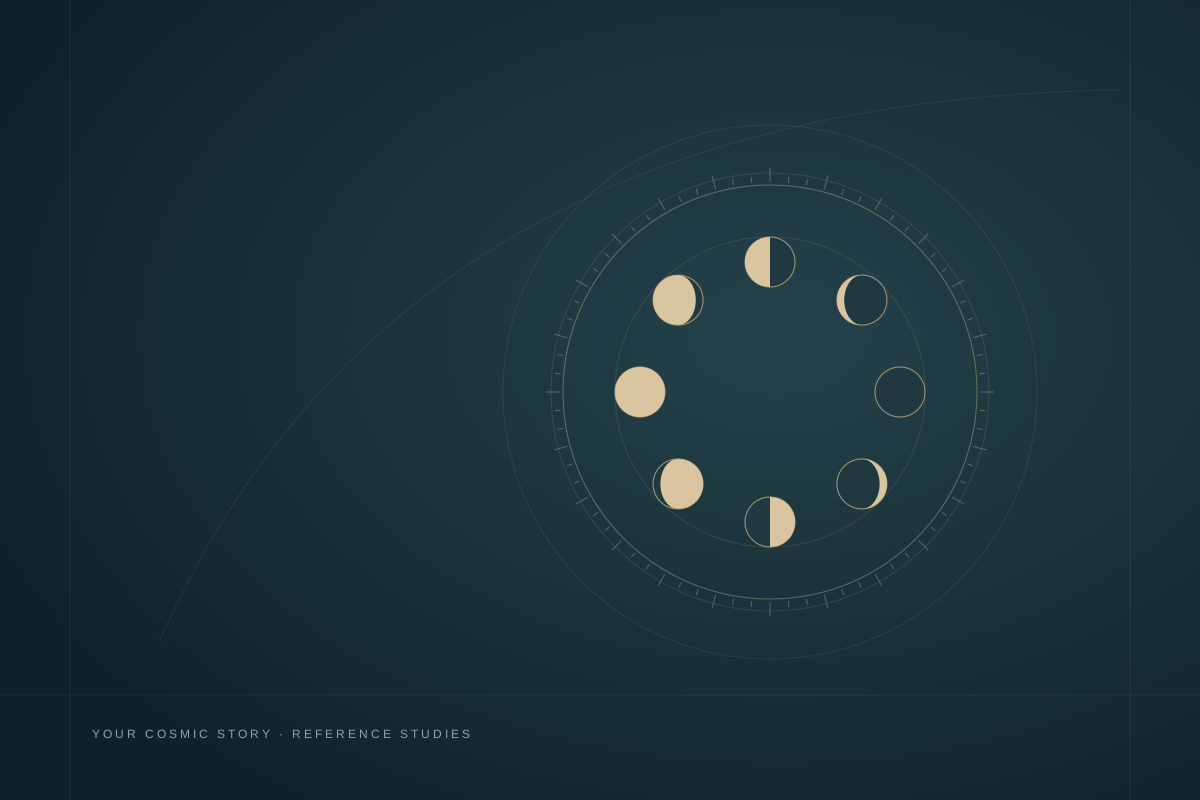
NASA’s phase guide names eight familiar stages. The drawings below fix one orientation to make the sequence easy to compare. Use the accompanying words, rather than a universal “right side means waxing” rule, when comparing them with a real observation.
The eight astronomical Moon phases
The four primary phases are exact events in a longitude-based definition. Crescent and gibbous describe the intervals between them. “Quarter” refers to progress through the cycle: a quarter Moon looks approximately half lit.
D in the table is the Moon’s directed longitude ahead of the Sun, wrapped into 0° to less than 360°. The appearance descriptions are approximate; longitude difference and exact illuminated fraction are distinct quantities in the real three-dimensional system.
| Phase | Directed arc | What to notice |
|---|---|---|
| New Moon | D = 0° | Conjunction in longitude; a new cycle begins. |
| Waxing crescent | 0° < D < 90° | The visible lit portion is growing and less than half. |
| First quarter | D = 90° | About half the visible disk is lit; the cycle is a quarter complete. |
| Waxing gibbous | 90° < D < 180° | The visible lit portion is growing and more than half. |
| Full Moon | D = 180° | Opposition in longitude; the visible disk is near fully lit. |
| Waning gibbous | 180° < D < 270° | The visible lit portion is shrinking and more than half. |
| Last quarter | D = 270° | About half the visible disk is lit; three quarters of the cycle have passed. |
| Waning crescent | 270° < D < 360° | The visible lit portion is shrinking and less than half. |
How to read the directed Sun–Moon arc
Subtract the Sun longitude from the Moon longitude, then add or subtract 360° until the result is at least 0° and below 360°. Keep the direction: a 270° arc is different from a 90° arc, even though both have a smaller separation of 90°.
Here are two separate invented comparisons. In A, the Sun is at 10° Aries (10° longitude) and the Moon at 10° Cancer (100°). D = 100 − 10 = 90°: first quarter. In B, the Sun is at 10° Libra (190°) and the Moon remains at 10° Cancer. D = 100 − 190 + 360 = 270°: last quarter.
The Moon sign and degree are identical in these examples. The phase changes because the Sun position changes. Neither example represents a person or calendar date. This is why a Moon-sign interpretation cannot identify a phase on its own.
Why is a lunar month about 29.5 days?
NASA distinguishes the Moon’s roughly 27.3-day orbit relative to the stars from the approximately 29.5-day phase cycle. Earth and Moon also move around the Sun, so returning to the same stellar direction does not yet restore the same Sun–Moon alignment.
The phase interval is the synodic month. Treat its average as an explanation of scale, not a date-finding shortcut. Adding a fixed number of days to an event is not a substitute for a dated astronomical source, and equal angular sectors need not last equal lengths of time.
Why can two sources give different phase labels?
Dane Rudhyar’s Your Lunation Birthday, archived as a 1950 article, divides the directed arc into eight 45° sectors. His sequence is New Moon, Crescent, First Quarter, Gibbous, Full Moon, Disseminating, Last Quarter and Balsamic. In that scheme, the labels name extended sectors rather than four instantaneous events.
For example, the New Moon sector runs from 0° up to 45°; Balsamic runs from 315° up to 360°. Here we include each lower boundary and exclude its upper boundary, so 45° belongs to the next sector. This explicit boundary rule avoids assigning a position to two labels.
At an invented D = 40°, the astronomical appearance is waxing crescent, while Rudhyar’s label is New Moon. At D = 280°, the astronomical appearance is waning crescent, while his label is Last Quarter. These are different classification rules, not two incompatible skies.
Before comparing apps or articles, ask whether the label describes appearance, an exact event or a named astrological sector. Rudhyar’s personality interpretations are not part of the geometry and are not established by getting the angle right.
What do the phases mean in astrology?
In CHANI’s contemporary practice, New Moon symbolism concerns beginnings and Full Moon symbolism concerns culmination. Those associations can provide prompts for reflection. They do not follow as scientific conclusions from the illuminated fraction or longitude calculation.
A simple exercise is to choose one ordinary project and write two questions: “What small step could I begin?” and “What result can I actually review?” Keep the dated observations separate from the symbolism. Record uneventful days and outcomes that do not match your expectation as carefully as memorable ones.
A natal phase compares the Sun and Moon at birth. A later lunar event compared with that chart is a transit reading. Continue with New and Full Moons as transits for that second task.
Is every New or Full Moon an eclipse?
No. A solar eclipse requires New Moon near either lunar node; a lunar eclipse requires Full Moon near a node. The orbital tilt usually keeps the alignment from producing an eclipse. The phase alone does not establish that additional geometry.
It also does not tell you whether a particular event is visible from your location. Use an astronomical observing source for visibility. The nodal-axis entry explains the crossing points; this guide supplies no eclipse calendar or personal prediction.
A four-line phase note
- Inputs: record the Sun and Moon longitudes from the same source, time and coordinate settings.
- Arc: calculate Moon minus Sun, preserving direction around the circle.
- Definition: name the astronomical stage or the specific astrological sector scheme.
- Reflection: write one question, then distinguish its answer from the positional facts.
If the source gives only rounded positions near a boundary, keep the label provisional. For a birth-phase reading, check whether uncertainty in the birth time could cross that boundary. Avoid replacing an unknown input with a confident character description.
A question to take with you
When a phase label feels meaningful, what belongs to the observable sky, what belongs to a named convention, and what comes from your own experience?
Sources & further reading
- NASA · Moon phases
The visible eight-stage sequence and reflected sunlight. Astronomy is kept separate from symbolic interpretation.
- US Naval Observatory · Phases of the Moon
Exact primary phase definitions, directed longitude, intermediate appearances and the astronomical use of lunation.
- NASA · Top Moon questions
Orbital versus phase-cycle periods, viewpoint and the distinction between ordinary phases and Earth’s shadow.
- Dane Rudhyar · Your Lunation Birthday, Part Four
Archived January 1950 article documenting his eight 45° sectors. We describe the classification, not its personality claims.
- CHANI · Moon phases and practice
A named contemporary source for symbolic beginning and culmination themes; not evidence of personal effects.
- NASA · Solar eclipse catalog introduction
New Moon near a node as an eclipse condition. No calendar entries are imported.
- NASA · Lunar eclipse catalog introduction
Full Moon near a node as an eclipse condition. Local visibility requires additional information.
These sources distinguish astronomical definitions from named astrological conventions. The worked positions, counting models and exercises are original teaching material. Interpretations are reflective prompts, not established predictions. Read our approach to astrology.