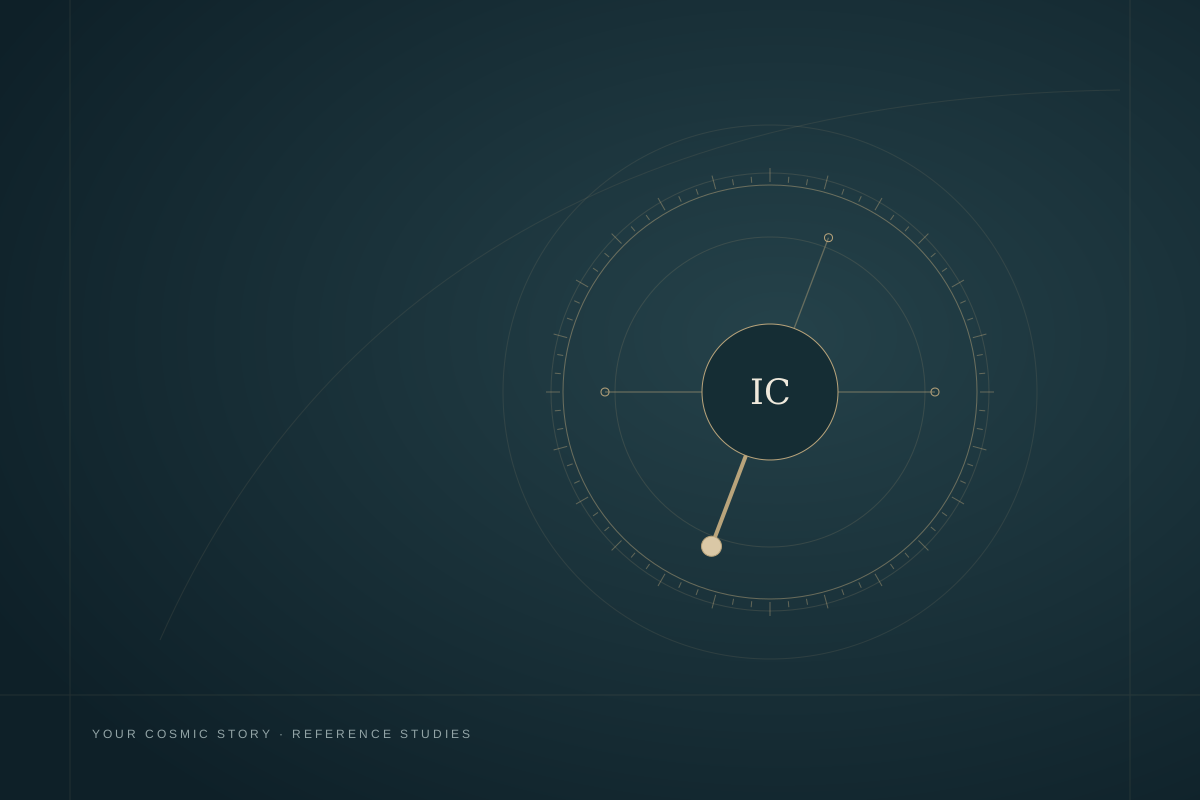
What is the Imum Coeli?
Imum Coeli, abbreviated IC, is the point opposite the Midheaven on the ecliptic in the ordinary chart geometry used here. It is the other end of the MC–IC axis; it is not generally the nadir or automatically the fourth-house cusp.
The other end of the meridian pair
With MC at 32.17° in our teaching model, IC lies at 212.17°: 2.17° Scorpio under the model’s sign labels. The two points are exactly 180° apart before rounding. IC is below the horizon in this particular construction.
A chart often draws IC near its bottom. That drawing choice should not be read as a scale of importance or as a physical point inside Earth. The diagram records a direction on the celestial sphere, not a planet or a material object.
Why IC is not generally the nadir
The nadir is directly opposite the zenith, along the local vertical. IC is directly opposite MC, along the ecliptic. These are different pairs. Only a special alignment would make both pairs coincide.
In our model, IC’s altitude is −42.21°, while the nadir’s is −90°. The 47.79° gap is the same as the gap between MC and zenith. See the meridian illustration to compare all four directions.
Calling IC the “bottom of the sky” can work as a metaphor, but it does not identify which geometric point a calculation used. Keep the abbreviation and the convention alongside the coordinate.
IC and the fourth boundary are separate labels
In our Whole Sign example, the fourth house begins at 210°, while IC is at 212.17°. In Equal houses starting from the ASC, the fourth begins at 232.94°, placing the example IC in the third house instead.
The IC coordinate did not move when the boundaries changed. The comparison table shows the paired fourth and tenth boundaries. Other systems can use MC and IC as the tenth and fourth cusps; their rules should be named rather than assumed.
The fourth-house article gives the wider house context. A shared topic in interpretation does not make every house boundary identical to an angle.
Reflect on home without inventing a family history
CHANI associates IC with roots, home and foundations. Our exercise asks what makes an everyday space feel supportive to you now. Begin with something observable: enough quiet, a place for a valued object, a useful routine or room to welcome someone.
Imagine setting up a corner where you can read after a demanding day. Choose one change, try it for a week and notice whether it helps. This original scenario concerns a choice you can evaluate; it is not evidence inferred from an IC sign.
An interpretation should not invent facts about your childhood, parents, ancestry or private relationships. You decide which experiences you want to explore and what you prefer to leave private. You can use a reflection prompt without supplying family documents or birth details.
Connect the private and public questions
The MC entry asks about contribution in a visible role. Alongside it, an IC-oriented question can ask what everyday support makes that contribution sustainable. Neither question requires choosing one side of life over the other.
IC inherits uncertainty in MC: adding 180° to an uncertain coordinate does not make it exact. Keep birth-time questions open where the inputs do not support an answer, and use the uncertain-time guide for the next step.
A question to take with you
What small, practical change could make an everyday space feel more supportive to you, on your own terms?
Sources & further reading
- US Naval Observatory · Astronomical Almanac glossary
Definitions of horizon, meridian, zenith, nadir and altitude.
- Dieter Koch & Alois Treindl · Swiss Ephemeris documentation
Sections 6.2.5, 6.2.11 and 6.4: house conventions and polar limits. Cited as documentation, not as a claim about this site’s calculation software.
- CHANI · MC, IC and DC
A practitioner source for broad symbolic themes only; its astronomy FAQ is not the basis of our diagrams.
The model and scenarios are original teaching material. Astronomy documents the geometry; practitioner sources describe a symbolic tradition. Neither the diagrams nor the reflection prompts are a personal chart or evidence of astrological effects. Read our approach to astrology.