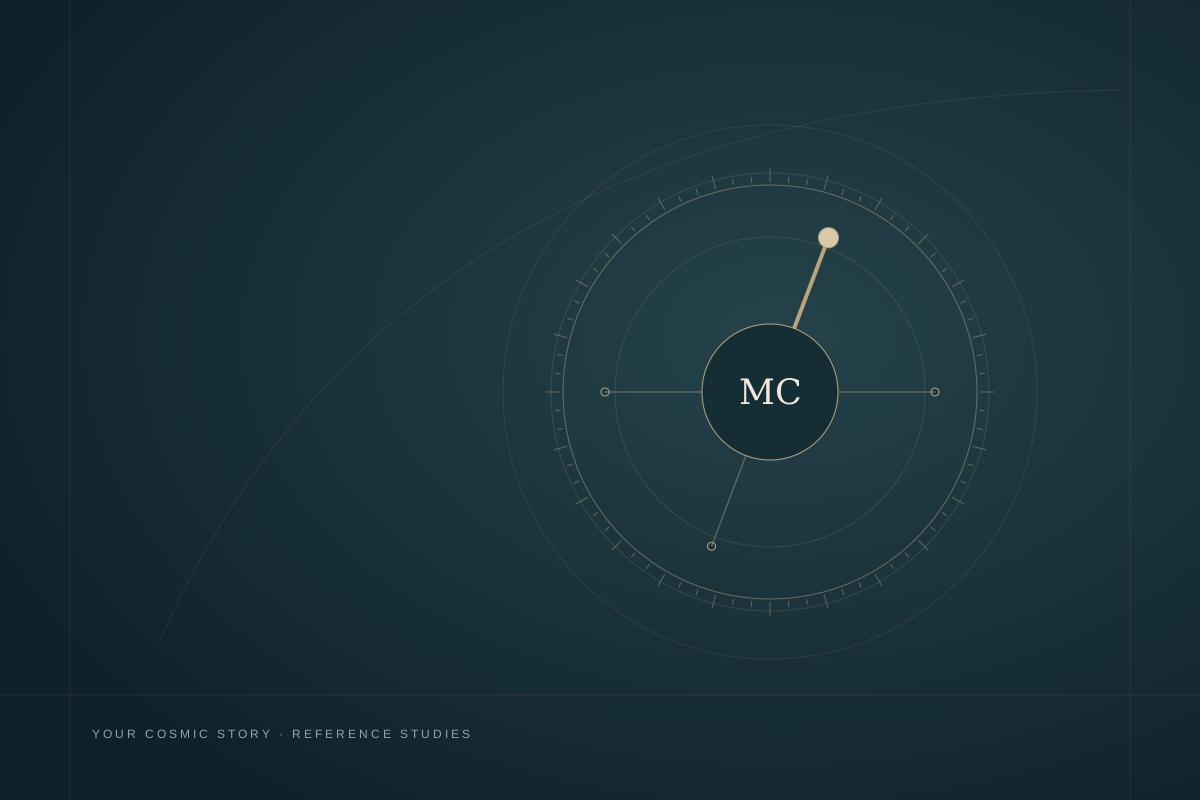
What is the Midheaven?
The Midheaven, abbreviated MC from Medium Coeli, is the ecliptic’s above-horizon intersection with the local meridian in the ordinary, non-polar setting used here. It is not generally the zenith, and it need not be the tenth-house cusp.
On the meridian does not mean overhead
The local meridian passes through the celestial poles and the zenith. MC is an ecliptic point on that meridian; the zenith is the direction directly overhead. A circle can contain both points without making them identical.
In our model, MC is 42.21° above the southern horizon. The zenith is 90° above the horizon, leaving 47.79° between the two directions. The meridian illustration on the overview shows the difference using the same model as the longitude wheel.
“At the top of the chart” is therefore a layout description, not a complete astronomical definition. Rotating a drawing to put MC at twelve o’clock does not place that point overhead.
Why MC and the tenth cusp can differ
Some house methods use MC as the tenth cusp; the Swiss Ephemeris documentation explicitly does so for Alcabitius. Equal-from-ASC and Whole Sign use different boundary rules. Their tenth cusps can therefore differ from MC while the angle itself remains unchanged.
In our example, MC is 32.17° longitude. The Whole Sign tenth house starts at 30°; the Equal-from-ASC tenth starts at 52.94°. MC falls in the tenth Whole Sign house and the ninth Equal house under this longitude-based exercise.
This is a comparison of conventions, not a recommendation of one reading. The boundary table keeps every assumption visible; the tenth-house entry provides that house’s broader context.
Explore a public role without predicting a career
CHANI associates MC with vocation and public roles. Our question is more specific: what contribution do you want people to be able to recognise in your work? That can concern paid work, volunteering, creative practice or another role that matters to you.
Imagine preparing a small portfolio. In this original exercise, choose three pieces that show what you actually do, write a plain explanation of each, and ask someone whether the intended contribution is visible. Their response gives you information you can use.
The exercise does not select a profession from an MC sign or promise recognition. Experience, opportunity, skill and other people’s decisions remain part of the real situation.
MC belongs to a pair and a local frame
The IC is opposite MC in ecliptic longitude. Their pair is sometimes used to reflect on public roles and private foundations. Those topics can support one another; they do not have to become competing halves of a life.
Time and geographical longitude establish the local sidereal orientation used to locate the meridian. A clock time also needs its date and correct time conversion. This reference does not infer your MC from a Sun sign or use a placeholder time to supply a personal result.
The ordinary above-horizon description is bounded: polar conventions can select or label angles differently. The overview’s limits explains why a service should state its convention.
A question to take with you
What contribution would you like to make clearer to others, and what concrete example could show it?
Sources & further reading
- US Naval Observatory · Astronomical Almanac glossary
Definitions of horizon, meridian, zenith, nadir and altitude.
- US Naval Observatory · Sidereal time
The connection between local sidereal orientation and geographical longitude.
- Dieter Koch & Alois Treindl · Swiss Ephemeris documentation
Sections 6.2.5, 6.2.11 and 6.4: house conventions and polar limits. Cited as documentation, not as a claim about this site’s calculation software.
- CHANI · MC, IC and DC
A practitioner source for broad symbolic themes only; its astronomy FAQ is not the basis of our diagrams.
The model and scenarios are original teaching material. Astronomy documents the geometry; practitioner sources describe a symbolic tradition. Neither the diagrams nor the reflection prompts are a personal chart or evidence of astrological effects. Read our approach to astrology.