What is the Ascendant?
The Ascendant, abbreviated ASC, is the eastern intersection of the ecliptic and local horizon in the ordinary geometry used here. The Rising sign is the zodiac sign containing that point. The coordinate, sign label and interpretation are three distinct things.
A point has a degree; a sign spans thirty
In our teaching model, the ASC is at 142.94° longitude: 22.94° Leo when the model’s zero is labelled 0° Aries. “Leo Rising” gives the sign, while “22.94° Leo” also gives the position within it. The shorter label cannot recover the exact degree.
The point is part of a geometric construction, not another planet. A different zodiac reference can change its longitude label without moving the physical horizon intersection. Begin with the zodiac guide if two reports use different reference frames.
Eastern does not always mean due east
The astronomical horizon is defined from the local vertical. It is different from the irregular line of hills or buildings you can see. The ecliptic generally meets the eastern half of that horizon away from the exact east compass point. In this reference, “eastern intersection” describes the geometric selection.
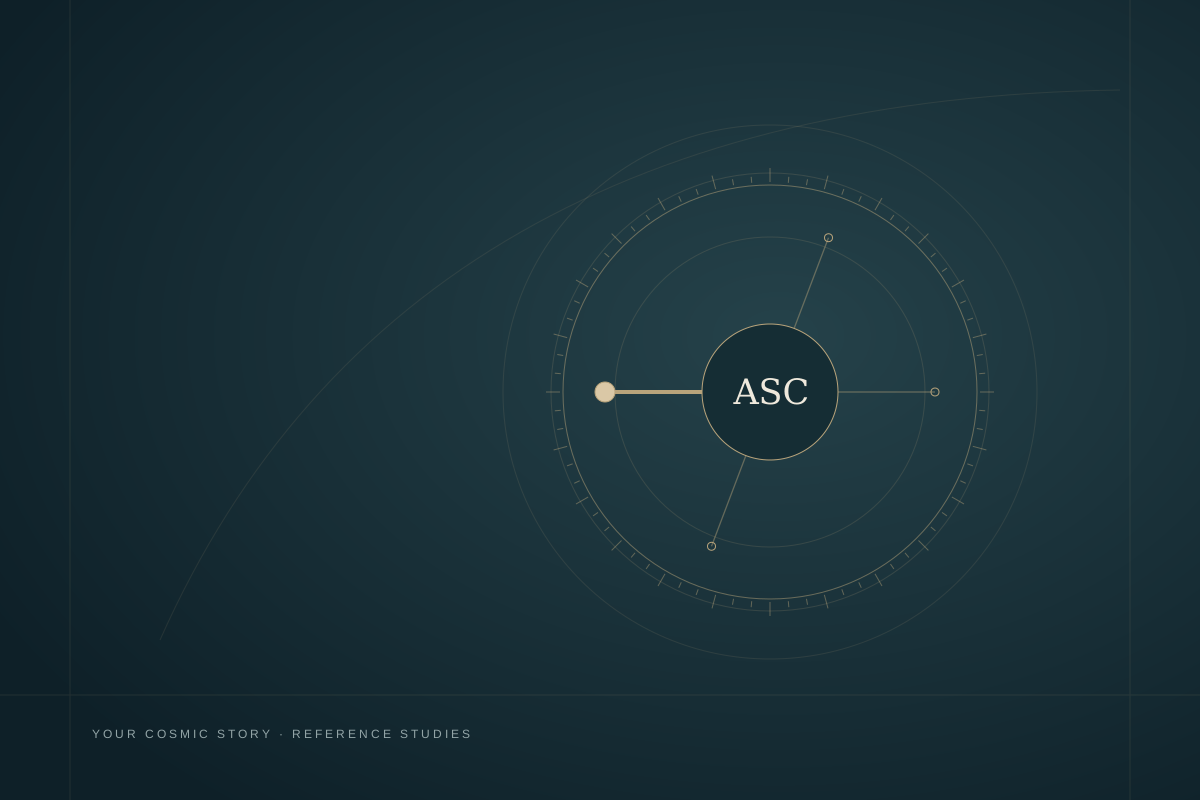
The axis diagram places ASC on the left as a drawing convention. Turning a chart on a screen does not change which point it represents. The circle shows ecliptic longitudes; it is not a photograph of the sky or a compass laid on the ground.
When does ASC mark the first house?
Equal houses starting at the Ascendant use its degree as the first cusp. Whole Sign houses start at the beginning of its sign. In our model those boundaries are 142.94° and 120° respectively. The same ASC lies on one boundary and inside the other first house.
This comparison keeps the point fixed while changing a house convention. Read the complete boundary table before treating a familiar chart label as the name of a house edge. Other methods need their own definitions.
Use the symbolism as a question
In their discussion of the Sun, Moon and Rising sign, Chani Nicholas and Chris Brennan treat the Ascendant as a distinct interpretive factor. Our exercise focuses on approaching something unfamiliar. Imagine arriving at a workshop where you know nobody: what information would help you take part comfortably?
You might ask how the session works, find a quiet place to begin or introduce yourself to one person. These are original possibilities for reflection, not behaviours assigned to a Rising sign. Notice what actually helps before fitting the experience to a description.
The opposite point, the Descendant, adds a way to explore meeting another person. Neither end of the pair contains a whole personality.
Keep an uncertain birth time visible
A supported time, its time conversion and the location matter when establishing the local frame. A rule of thumb about one Rising sign every two hours is not a reliable interval check for an individual chart. Latitude and the position of the ecliptic affect the geometry.
If the time is unknown, keep the ASC open rather than presenting a default-time result as recovered information. Our uncertain-time guide explains how to distinguish a recorded time, an estimate and an untested interval.
A question to take with you
Think of an unfamiliar situation you are approaching. What one thing could you ask or arrange that would make your first step easier?
Sources & further reading
- US Naval Observatory · Astronomical Almanac glossary
Definitions of horizon, meridian, zenith, nadir and altitude.
- US Naval Observatory · Sidereal time
The connection between local sidereal orientation and geographical longitude.
- Dieter Koch & Alois Treindl · Swiss Ephemeris documentation
Sections 6.2.5, 6.2.11 and 6.4: house conventions and polar limits. Cited as documentation, not as a claim about this site’s calculation software.
- Chani Nicholas & Chris Brennan · The Sun, Moon and Rising sign
An original practitioner discussion distinguishing the three interpretive factors.
The model and scenarios are original teaching material. Astronomy documents the geometry; practitioner sources describe a symbolic tradition. Neither the diagrams nor the reflection prompts are a personal chart or evidence of astrological effects. Read our approach to astrology.