The short answer
Placidus is a quadrant house system whose intermediate cusps use divisions of the individual ecliptic points’ daily arcs. The Ascendant and Midheaven anchor houses one and ten in the ordinary construction; the remaining zodiacal widths can vary.
The angles establish the framework
In the ordinary quadrant construction, Ascendant, IC, Descendant and MC anchor houses one, four, seven and ten. Intermediate boundaries depend on the chosen division rule. Sharing these anchors does not make different quadrant systems identical.
Placidus uses fractions of each ecliptic point’s own rise-and-set path. On the eastern upper part of the sky, cusp twelve has completed one-third of its rise-to-upper-culmination interval; cusp eleven has completed two-thirds. Simply cutting the zodiacal arc between Ascendant and MC into three equal pieces describes a different method, Porphyry.
Each point has its own time interval
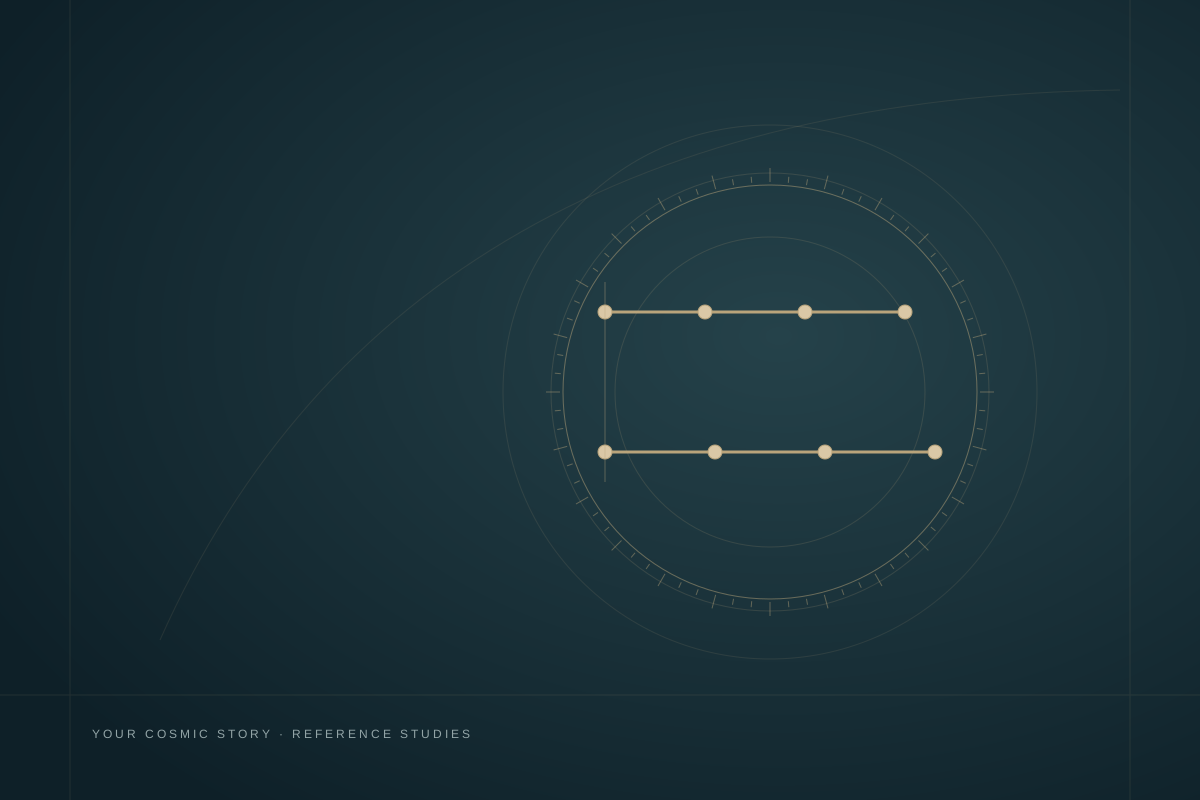
To understand “its own,” compare two fixed directions at latitude 40° north. In our idealized model, one has declination 0° and the other +20°. Declination measures angular distance north or south of the celestial equator. Their rising-to-upper-transit intervals are 6.00 and about 7.19 sidereal hours respectively.
One-third of the first interval is 2.00 hours; one-third of the second is about 2.40. The fractions match while the durations differ. The rows below start at each point’s own rising event, not at a shared clock time. They illustrate the principle, not a set of calculated Placidus cusps.
Geometry and assumptions behind the figure
For latitude φ and fixed declination δ, the ideal horizon crossing satisfies sin φ sin δ + cos φ cos δ cos H = 0. Hence the positive semi-diurnal hour angle is H₀ = arccos(−tan φ tan δ), and its duration is H₀ / 15 sidereal hours when H₀ is measured in degrees. With φ = 40°, the two hour angles are 90° and approximately 107.783°. The model ignores refraction and changes in the point’s celestial coordinates. A value outside the arccos domain means this rise/set construction is unavailable.
To obtain actual Placidus cusps one must solve for the individual ecliptic points at a specified local sidereal time, including the ecliptic-to-equatorial geometry. This figure deliberately stops at the time-fraction principle.
Why this does not make twelve 30° houses
A cusp calculation must find the ecliptic point satisfying the required fraction at the chart’s time and place. The two-row illustration cannot supply those cusp longitudes: it has no selected local sidereal time or complete set of ecliptic points. Assigning its tick marks directly to zodiac degrees would mix two different measurements.
When inspecting a finished chart, read its listed cusp degrees rather than measuring wedges on a decorative wheel. Some displays stretch houses to equal visual widths. A large-looking sector is therefore not always a large interval of zodiac longitude, and neither size establishes the importance of a life topic.
What an intercepted sign means
An intercepted sign is completely contained inside one house, with no house cusp in that sign. As an invented boundary exercise, take a house beginning at 25° Taurus and ending at 5° Cancer: its interval runs from 55° to 95° and contains all of Gemini, 60° to 90°.
Those two example boundaries demonstrate the definition; they are not asserted to be the output of a particular Placidus calculation. The sign remains present. Interpretation of interception varies, and the geometry does not establish a blocked trait, a missing ability or a personal defect.
How to find an intercepted sign
Read the listed cusp degrees before interpreting the wheel. A drawing can use equal visual sectors even when its underlying house intervals are unequal. For this longitude-based exercise, start with one cusp and move forward through the zodiac to the next.
- Write both boundaries as absolute longitude: Aries begins at 0°, Taurus at 30°, Gemini at 60° and Cancer at 90°.
- List the complete 30° signs inside that interval. A sign cut by either boundary is not wholly enclosed.
- Check the cusp list: an intercepted sign has no cusp in it. A cusp exactly at 0° of the sign belongs to that sign, so the sign is not intercepted.
- Keep the house system, zodiac and birth-time assumptions with your answer.
In our existing example, 55° to 95° spans 40°. Gemini occupies 60° up to 90°, entirely between those boundaries. Taurus contributes only its final 5°, and Cancer only its first 5°. This is enough to demonstrate interception without claiming to calculate a complete Placidus chart.
Three boundary exercises, one definition
| Boundaries | Width | Result |
|---|---|---|
| 25° Taurus → 5° Cancer | 40° | Gemini is intercepted. |
| 5° Gemini → 15° Cancer | 40° | No complete sign is enclosed. |
| 25° Aquarius → 5° Aries | 40° | Pisces is intercepted across the 0° wrap. |
A house wider than 30° does not automatically intercept a sign. In the second row, the interval is 65°–105°: it contains parts of Gemini and Cancer, but neither complete sign. For the last row, unwrap 5° Aries from 5° to 365°. The interval 325°–365° encloses Pisces, 330°–360°.
Try it: does an interval from 0° Gemini to 10° Cancer intercept Gemini?
Check your answer
No. Gemini starts at the first cusp itself. All of Gemini lies in the house, but there is a cusp in Gemini, so the no-cusp condition fails. Read both parts of the definition.
Why Whole Sign and Equal do not intercept signs
In Whole Sign houses, every sign begins a house. In Equal houses from the Ascendant, consecutive cusps are 30° apart, so each sign receives one cusp at the same degree within the sign. Neither arrangement leaves a complete sign without a cusp.
Unequal house widths can allow interception, but it is not present in every Placidus chart. A change of method may remove the classification while leaving every planet at the same zodiac longitude. That does not mean a planet has moved or a personal difficulty has been resolved. Use the method-comparison worksheet to record the settings and the difference.
A repeated cusp sign is a different observation: the same zodiac sign appears at the start of more than one house. Scan all twelve cusp labels to find repeats and signs with no cusp. Do not describe a house itself as missing; a standard twelve-house report still has twelve numbered boundaries.
Intercepted planets, empty houses and rulers
A planet described as “intercepted” is located in a sign that meets the interception definition in the selected house system. An empty house has no planets from the chosen object set. These are different questions: one concerns boundaries, the other occupancy. A sign can be intercepted whether or not a planet is placed in it.
Place an invented Mercury marker at 12° Gemini, or 72°, inside our 55°–95° house. Mercury is in Gemini and in that house. Remove the marker and the interception remains, because neither boundary changed. This is a teaching placement, not a calculated sky configuration.
Also keep the rulers distinct. The sign at the first boundary is Taurus, whose ruler in the rulership table is Venus. Gemini’s sign ruler is Mercury. Naming the ruler of the cusp sign and naming the ruler of the intercepted sign answers two different questions; interception does not change the rulership table.
Practitioners attach different symbolic meanings to interceptions. The boundary exercise establishes none of those psychological claims. Treat any interpretation as a named tradition’s reading, not a diagnosis or evidence of a missing ability. If birth time or the actual house method is uncertain, establish those inputs before interpreting an interception.
Read polar limitations and fallback labels
At high latitudes, some directions do not rise or set, so the arcs needed by this construction can be unavailable. The Swiss Ephemeris interface documents returning Porphyry cusps with an error indicator for unsupported Placidus cases. That is a behavior of the documented implementation, not a promise about every chart program.
Look for three separate fields: requested method, actual method and warning. “Requested: Placidus; used: Porphyry; reason: unavailable at these inputs” makes the result reviewable. An unexplained wheel still labeled Placidus does not. Consult the established guide to house limits when a report omits this information.
Keep the interpretation attached to its assumptions
Use the cusp table to locate one position, then record the house convention alongside the result. Ordinary longitude-only placements and methods incorporating a body’s ecliptic latitude are separate conventions; check which a technical report uses.
Return to the comparison worksheet before choosing between reports. A calculation can be internally consistent while its symbolic reading remains a matter of interpretation. You can explore the twelve life-area entries without treating a system’s complexity as proof of predictive accuracy.
A question to take with you
Does your report state the method it actually used, and can you keep a change in geometry separate from a claim about yourself?
Sources & further reading
- Dieter Koch & Alois Treindl · Swiss Ephemeris documentation
Sections 6.2 and 6.4–6.5 document construction and limits. The figures and numerical exercises here are original; no Swiss Ephemeris code is used.
- Chris Brennan & Luís Ribeiro · House division calculations
Their original discussion explains constructions and the difference between meridian angles and house boundaries. It does not establish one method as scientifically predictive.
- Astrodienst · Swiss Ephemeris programming interface
Sections 15–16 distinguish house methods, separate angle outputs, warnings and position conventions. Fallback behavior is attributed to this implementation.
- April Elliott Kent · Cusps and interceptions
Used for the practitioner term “intercepted sign” and the existence of differing cusp-interpretation conventions, not for claims of hidden psychological effects. Its angle-to-cusp shorthand does not apply to all house systems.
Geometry describes the construction; astrological interpretations belong to particular traditions. Our examples and diagrams are original. Read our approach to astrology.