The short answer
Whole Sign assigns the entire sign containing the Ascendant to house one, then counts the following signs as houses two through twelve. Each house spans 30°; its boundary follows a sign boundary.
Begin with one complete sign
Find the Ascendant’s sign before reading the house numbers. In this convention, a Taurus Ascendant makes Taurus the first house, Gemini the second and Cancer the third. The count continues around the zodiac and returns to Aries as the twelfth. Changing from early to late Taurus rising does not change that sequence.
A house still names a life area, while a sign supplies a different layer of symbolism. Sharing boundaries does not make these concepts interchangeable. Taurus is not inherently the first house: it fills that role only in this example. With Libra rising, Libra would begin the count.
A wheel you can reconstruct
Imagine an Ascendant at 12° Taurus, or absolute longitude 42°. Taurus occupies longitudes 30° up to 60°, so those are the first house’s boundaries. The exact rising point lies 12° inside that interval. House two begins at 60°, house three at 90°, and the sequence advances by 30° each time.
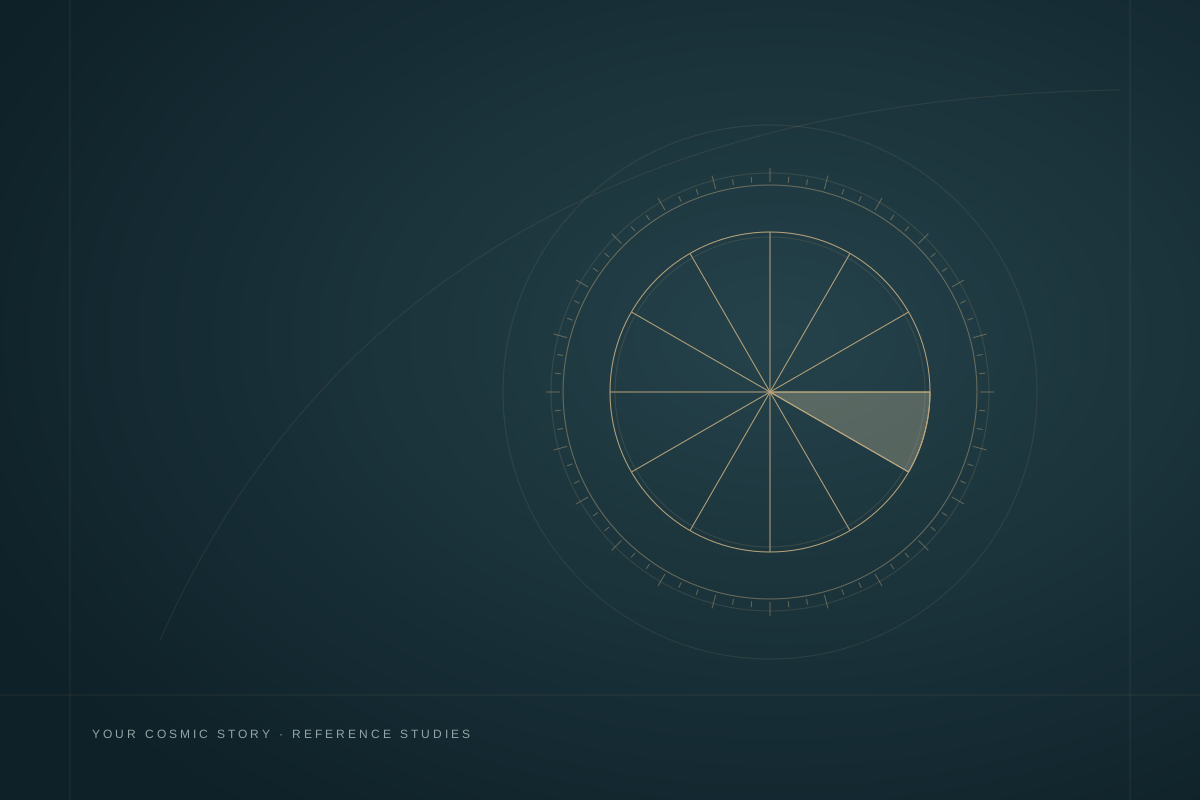
The figure marks the Ascendant separately from the first boundary. Its house numbers are the result of counting signs, not a measurement of strength or importance. The wheel is an invented coordinate exercise, with no birth date or personal chart attached.
Keep the marker still
Place a marker at 8° Taurus, longitude 38°. It is within the Taurus interval, so this example puts it in house one. On an Equal chart with the same 42° Ascendant, house one begins later, at 42°: the unchanged marker is in house twelve.
Write the comparison as two statements: “38°, house one, Whole Sign” and “38°, house twelve, Equal from Ascendant.” The sign and degree match. The house label differs because its boundary was defined differently. This format is more informative than saying that the planet moved when you changed a menu setting.
Keep the Midheaven visible
The meridian Midheaven remains a chart angle; it need not begin the tenth Whole Sign house. In our Taurus-rising example, house ten starts at 0° Aquarius because Aquarius is the tenth sign in the count. That fact alone does not give the MC’s degree.
If a report draws both, label the tenth-house boundary and the MC separately. Compare the Midheaven entry with the tenth-house entry before combining their symbolic themes. Do not move the MC to the nearest house boundary to make a wheel look familiar.
What uncertain birth time still changes
Whole Sign needs the rising sign to be established. If the possible birth-time interval crosses a change of rising sign, the entire house sequence may change. A coarse division is not a substitute for missing input.
As a practice exercise, compare two hypothetical possibilities: late Taurus rising and early Gemini rising. The Taurus marker at 38° moves from house one to house twelve under the second possibility. Here the cause is a changed Ascendant, unlike the earlier example where the Ascendant stayed fixed and only the method changed. Record these as different questions.
Turn the count into a careful reading
Choose one marker and write down its sign, degree and house before opening an interpretation. Then consult the house reference for the life area being discussed. Separate a factual entry such as “house one by this convention” from a reflective question such as “How do I approach a new situation?”
A useful reading leaves room for experiences that do not fit its wording. A geometrically consistent chart demonstrates that a rule was followed; it does not establish that a description predicts a person’s life. Use the comparison worksheet to keep those two tasks distinct.
A question to take with you
Which part of a chart statement names a sign, which part names a house, and which part is an interpretation you could examine?
Sources & further reading
- Chris Brennan & Kelly Surtees · The issue of house division
The opening technical comparison distinguishes Whole Sign, Equal and quadrant conventions. Personal preferences and historical priority claims are not adopted here.
- Dieter Koch & Alois Treindl · Swiss Ephemeris documentation
Sections 6.2 and 6.4–6.5 document construction and limits. The figures and numerical exercises here are original; no Swiss Ephemeris code is used.
Geometry describes the construction; astrological interpretations belong to particular traditions. Our examples and diagrams are original. Read our approach to astrology.