The short answer
A midpoint composite chart combines matching placements from two natal charts into one derived chart. Practitioners interpret it symbolically as a relationship chart; synastry instead retains the two natal charts for comparison.
Join matching placements, then read the new chart
The composite Sun comes from Sun with Sun; the composite Moon from Moon with Moon. It is not made by averaging every planet into one point. Astro Gold’s documented midpoint method starts with the shorter arc between corresponding positions.
Once those derived placements exist, an aspect inside the composite compares two of the new points. That calculation differs from A’s Sun aspecting B’s Moon in synastry. Keep the chart type attached to an aspect label so a “Sun–Moon square” is not moved between methods without explanation.
The finished drawing resembles a natal chart, but a midpoint composite is not generally a sky configuration that occurred at a single moment. Astrodienst notes that composite Mercury or Venus can appear opposite the Sun—one reason the familiar wheel should not be mistaken for an ordinary birth chart.
A midpoint that crosses the zodiac’s zero
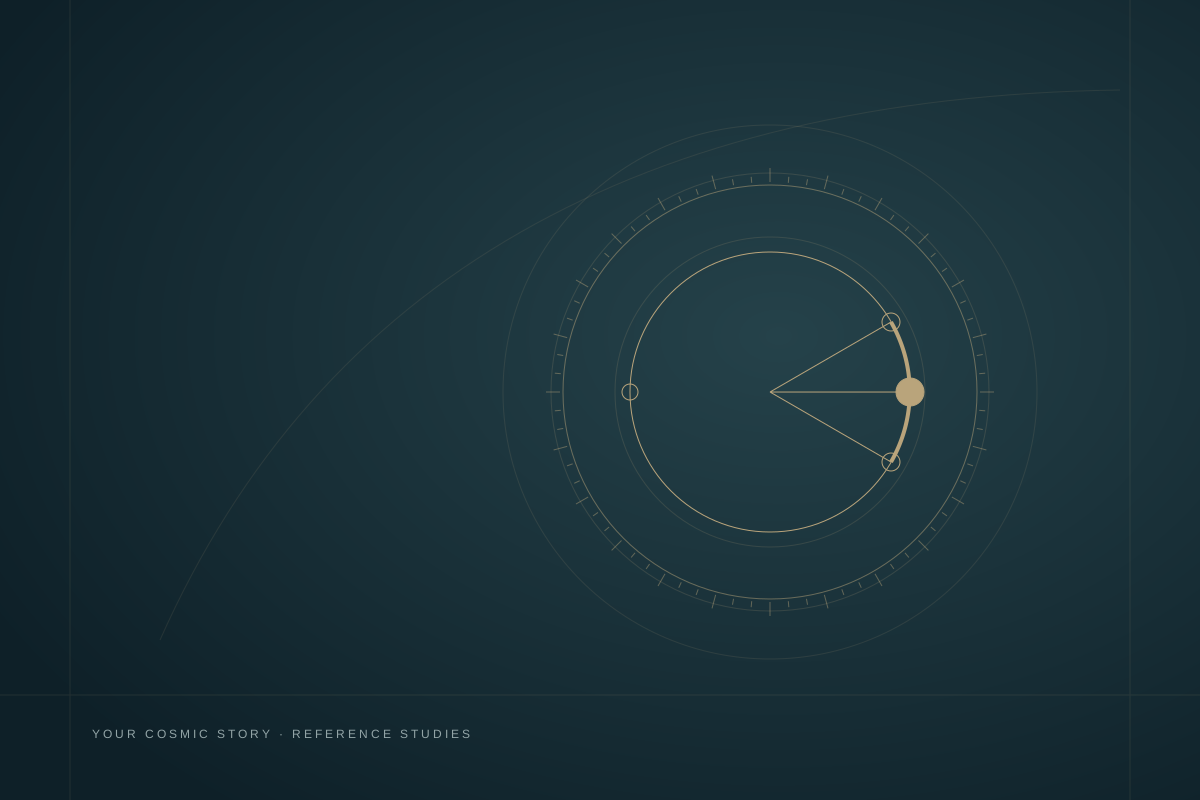
Imagine two natal Suns at 330° and 30°. The shorter connecting arc is 60°, crossing zero. Travel 30° from 330° along that arc and arrive at 360°, which is the same direction as 0°. That is the selected short-arc midpoint in this example.
Simply averaging the printed numbers gives (330 + 30) ÷ 2 = 180°. This selects the other midpoint, halfway along the longer arc. Both are halfway around an arc, but only 0° lies on the chosen shorter one. The circular coordinate matters.
What happens at an exact opposition?
With matching positions at 90° and 270°, both connecting arcs are 180°. There is no uniquely shorter arc. Their two midpoints are 0° and 180°, each 90° from both inputs. Our example therefore leaves the short-arc choice unresolved rather than silently selecting a point.
Near that boundary, a small input change can switch which branch is shorter. For invented inputs of 90° and 269°, the short-arc midpoint is 179.5°. Change the second input to 271° and it becomes 0.5°. This is a change of selected arc, not evidence of a sudden change in a relationship.
These examples explain why averaging does not automatically make uncertain information harmless. Retain the input ranges and the software’s midpoint convention, especially near opposition. The illustration is a teaching model; it is not a calculator for your chart.
Why two composite charts can have different houses
Astrodienst documents two approaches. Its midpoint method combines corresponding axes and cusps. Its reference-place method first combines the MCs, then derives the Ascendant and houses using that MC and a selected geographical latitude. These are distinct construction choices.
Astro Gold documents another implementation detail: if short-arc cusp midpoints fall out of zodiacal order, its Auto Anchor procedure adjusts selected cusps to long-arc midpoints. This describes that program’s handling of the problem, not a universal instruction for every composite.
Astrodienst also notes that some drawing styles shift a composite Mercury or Venus by 180° to keep it near the Sun. When comparing outputs, record the program, chart type, house procedure, reference location where relevant, and any such convention. Matching only the two birth dates is not a complete settings check.
Composite, synastry and Davison answer different questions
Synastry
Keep two natal charts and compare placements, cross aspects and house overlays. There is no single new set of midpoint planets to read.
Midpoint composite
Derive matching chart positions first. Read the resulting constructed chart under a stated midpoint and house convention.
Davison relationship chart
Derive a time and location from the two birth records, then calculate a chart for those inputs. The operation occurs before the planetary chart is cast.
The simple Davison method described in Astro Gold uses midpoint time, latitude and longitude. Astrodienst also offers corrected, reference-place and spherical-midpoint variants; its corrected version adjusts time so the resulting MC matches the composite MC. “Davison” therefore needs a variant label when exact settings matter.
These labels do not establish that one method can reveal a relationship’s outcome more accurately. Begin by identifying which construction you are actually looking at, then use the relationship overview to choose the relevant reading path.
Keep the people beside the constructed chart
For an original reflection exercise, imagine a composite reading prompts a question about shared priorities. Each person first writes one aim they want to pursue together and one they want to keep individual. Compare the answers before consulting a symbolic description. A difference is information to discuss, not something a midpoint can overrule.
Ask what a composite description adds to that conversation. Does it supply a useful word, or does it flatten two different experiences into a single story? Return to the separate natal contexts and to each person’s own account. The relationship-as-a-unit frame should not erase either individual.
Uncertain birth information remains relevant to derived angles, houses and time-sensitive planetary positions. A precise-looking wheel does not recover a missing birth time. Mark what is known, what is assumed and what has not been calculated.
A mathematical construction is not evidence that its interpretation predicts attraction, compatibility or duration. Read this as a way to understand an astrological method and its vocabulary. Decisions about a relationship still depend on the people, their choices and their lived circumstances.
A question to take with you
When a description speaks about “the relationship,” what would you still want to ask each person separately?
Sources & further reading
- Astro Gold · Chart Options, Combined section
Official manual: short-arc midpoint construction and the separately calculated Davison method.
- Astrodienst · Composite Chart, Midpoint method
Official help: matching points, midpoint versus reference-place houses and alternative Mercury/Venus handling.
- Astro Gold · Combined Midpoint Houses
Official manual: the program’s Auto Anchor convention for maintaining the zodiacal order of composite house cusps.
- Astrodienst · Davison Relationship Chart
Official help: corrected, uncorrected, reference-place and spherical-midpoint variants. A variant name matters when comparing results.
Software documentation establishes calculation and display conventions; practitioner sources describe their own approaches. Our coordinates, diagrams and exercises are original learning aids. They do not calculate personal charts or demonstrate predictive validity. Read our approach to astrology.