The short answer
Synastry aspects compare placements from two separate natal charts. In a degree-based method, a shared zodiac reference, an angular separation and a stated orb allowance determine which cross-chart contacts are included.
Keep both chart labels attached
An interaspect needs two complete labels: whose placement, and which planet or point? “A’s Mercury sextile B’s Moon” is a different pair from “B’s Mercury sextile A’s Moon.” Writing only “Mercury–Moon” loses information that matters to a comparison.
A bi-wheel draws two sets of placements around a common centre. An aspect grid puts one chart’s placements along one edge and the other chart’s along another; read the row and column before interpreting the cell. Astro Gold’s documentation shows this distinction in its two-chart sheets. The number or colour of drawn lines is a display choice, so use the printed longitudes and aspect list when checking a contact.
Start with our synastry introduction if the overall method is unfamiliar. This entry focuses on the angular comparison, rather than on which houses receive the placements.
A worked example across zero
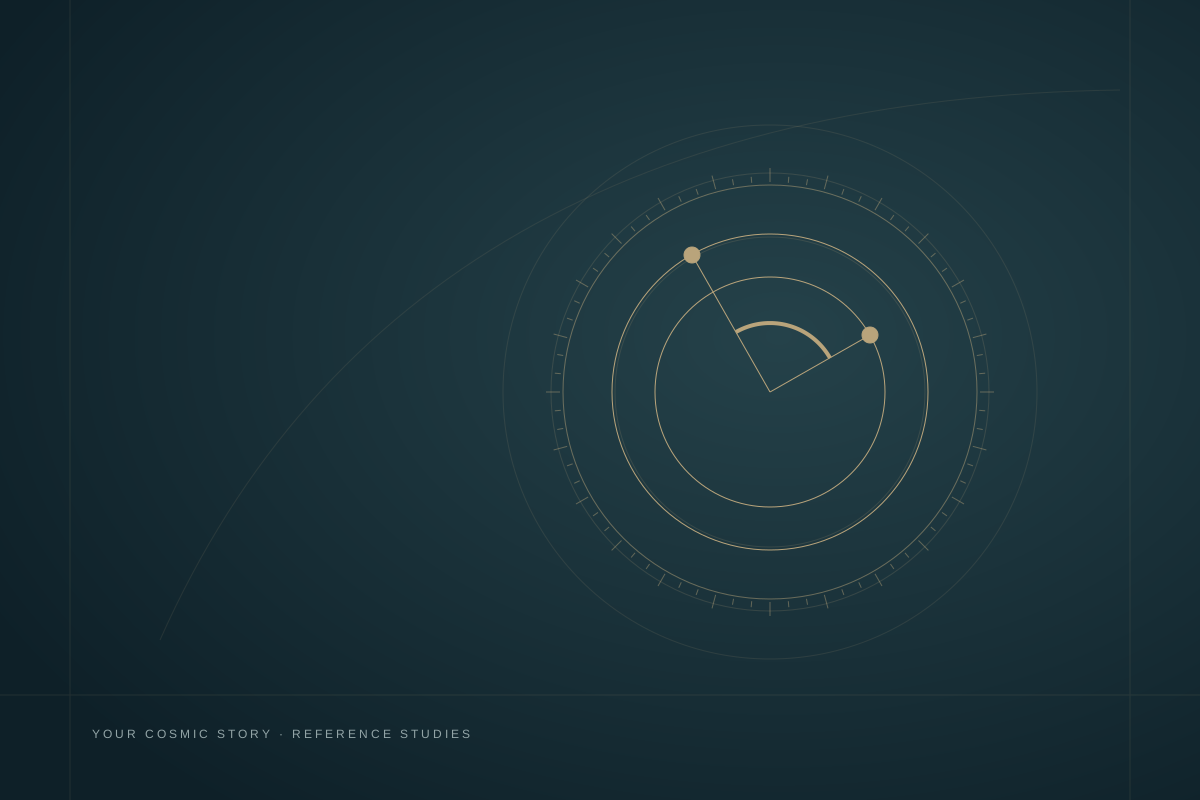
Imagine A’s Mercury at 358° and B’s Moon at 61°, measured from the same zodiac zero. These are invented teaching coordinates, not calculated birth charts. Direct subtraction gives 297°, but the shorter route around the circle crosses zero and covers 63°: 2° to zero, then 61° further.
A sextile’s exact target is 60°, so this pair is 3° from exact. A hypothetical 4° allowance includes it; a 2° allowance excludes it. The positions have not changed. The chosen inclusion rule has. Neither allowance is presented as a universal synastry setting.
The calculation can be repeated from the other endpoint: the shorter separation remains 63°. Redrawing the same two placements in opposite rings does not create a new angular relationship.
Record the rule before reading the result
Astro Gold allows aspect sets and orb allowances to be changed. Its documentation also separates sign-based configurations from degree-based tests. This is why two reports can display different contact lists without either having copied the birth information incorrectly.
For a reproducible comparison, record the zodiac reference, the selected planets and points, the aspect angles and the allowance for each. If the chart uses a sidereal zodiac, retain its named ayanamsha. Do not compare one tropical longitude with one sidereal longitude as though both had the same zero.
A small deviation describes a close fit to an angular target under those rules. It is not a measured amount of affection, difficulty or relationship importance. Our aspect overview explains the difference between an orb and an allowed orb.
Reversing the wheel is not swapping the planets
Keep the first pair above, then invent a second: B’s Mercury at 210° and A’s Moon at 28°. Their raw difference is 182°, so the shorter separation is 178°—2° from opposition. This second pair answers a different question from A’s Mercury at 358° and B’s Moon at 61°.
A compact note therefore reads “A Mercury / B Moon: 63°, 3° from sextile” on one line and “B Mercury / A Moon: 178°, 2° from opposition” on another. Both may appear in one comparison. There is no contradiction to resolve by deciding which person has the “correct” Mercury–Moon contact.
These are two natal snapshots from potentially different dates. Their static longitudes alone do not establish that a contact is applying or separating. A method using those labels must also specify how it treats motion and the two reference times.
From a contact to a useful question
In his discussion with Chris Brennan, John Green describes looking at the individual natal charts before drawing conclusions from their comparison. We adopt that sequence as a reading discipline, without treating it as proof of predictive validity.
For an original reflection exercise, take the familiar Mercury vocabulary of expression and the Moon vocabulary of emotional response. Instead of writing “one person always understands the other,” ask: when one of us needs time to think, what response actually helps? Each person can answer separately before comparing notes.
Suppose A prefers to draft a difficult message and B prefers a conversation. A useful outcome is a practical agreement about when to write and when to talk. That agreement comes from what the people say and do. The aspect supplies a theme to explore; it does not establish either preference on their behalf.
Read other chart factors alongside the contact, and keep examples that fail to fit the proposed theme. A long list of favourable labels cannot substitute for listening. A difficult-sounding label does not determine how a disagreement will be handled.
A six-line note for one interaspect
- People and points: identify A’s placement and B’s placement in full.
- Coordinates: copy both longitudes and the common zodiac convention.
- Geometry: find the shorter separation and the chosen exact aspect.
- Allowance: record the deviation and the rule used to include it.
- Uncertainty: note which placements depend on uncertain birth information.
- Conversation: write one question that both people can answer in their own words.
If a birth time is missing, check how much a relevant placement can vary over the known interval, particularly the Moon. Do not label an angle contact as precise when the angle itself is unknown. Continue with the birth-time guide for a fuller treatment.
A question to take with you
Which part of your note is a coordinate, which is a convention, and which is a question that still needs a real answer?
Sources & further reading
- John Green & Chris Brennan · Synastry: the astrology of relationships
Primary practitioner discussion: individual natal context before comparison. Interpretive claims are not evidence of predictive accuracy.
- Astro Gold · The Sheets
Official Windows manual, two-chart sheets: bi-wheels, inter-chart grids and aspect lists with chart labels and orbs.
- Astro Gold · Aspects
Official iOS manual: configurable aspect sets, orbs and separate sign-based conventions. We do not prescribe its factory defaults.
- CHANI · Working without a birth time
Practitioner explanation of time-sensitive Moon and angle placements; its house discussion uses whole-sign houses.
Software documentation establishes calculation and display conventions; practitioner sources describe their own approaches. Our coordinates, diagrams and exercises are original learning aids. They do not calculate personal charts or demonstrate predictive validity. Read our approach to astrology.