What is an opposition?
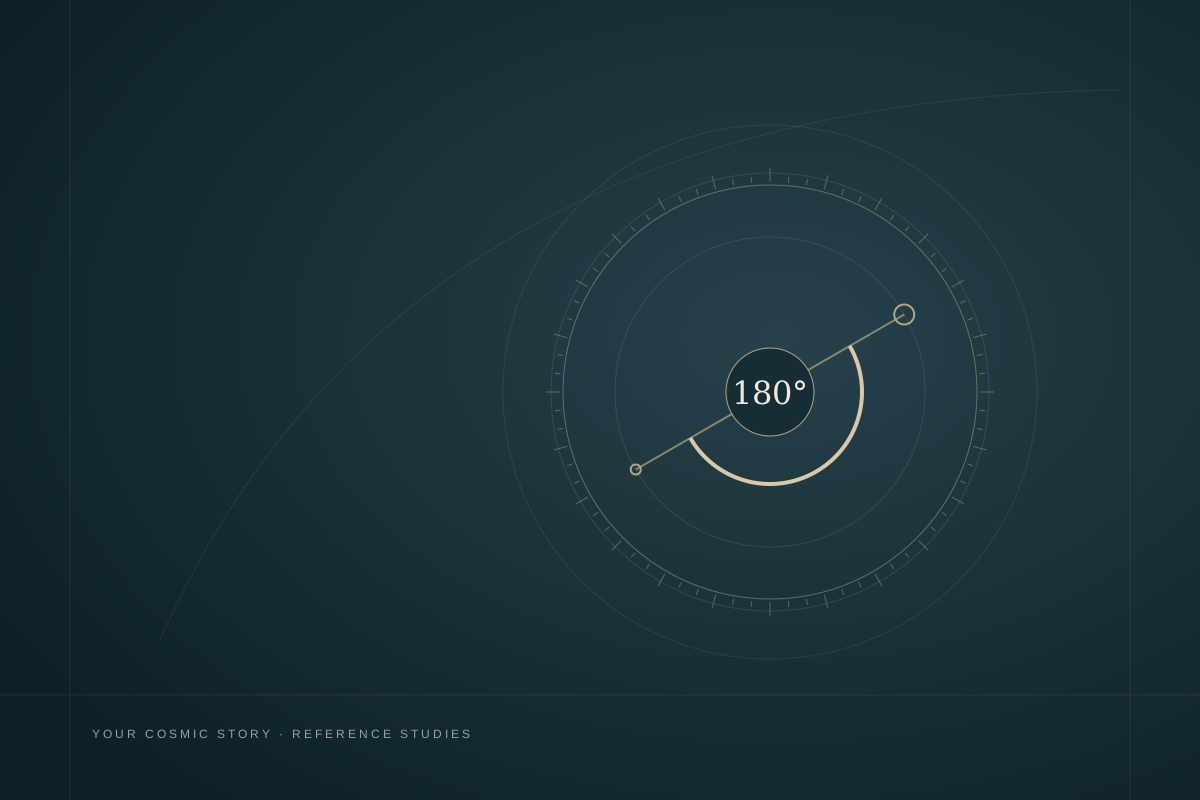
An opposition is an aspect centred on a 180° difference in ecliptic longitude. In a degree-based reading, positions count as opposed when their deviation from 180° is within the chosen orb.
These entries use a degree-based convention. Compare all five in the aspect reference, or start with the beginner’s guide.
The angle, made visible
INVENTED POSITIONS · NOT A PERSONAL CHART
- A
- 28° Pisces · 358° longitude
- B
- 26° Virgo · 176° longitude
- Separation
- 178°
- Exact target
- 180°
- Orb
- 2°
- Example allowance
- 3° · included
Two invented positions with a raw difference of 182° and a shorter separation of 178°: a 2° orb from opposition.
What does an opposition mean?
Cafe Astrology frames the opposition through polarity and relationship. Our reflection gives each side of a question a hearing, without assuming that two people or two needs must conflict.
Consider an invented Venus–Saturn opposition. The Venus and Saturn entries introduce relating and limits as selected symbolic themes. This exercise is to plan a social commitment within a realistic schedule. What matters about connection, and what matters about the boundary? The useful outcome is a clearer decision, not a prediction derived from an angle.
Half a circle, across the zero point
An exact opposition divides a full circle in half: 360° ÷ 2 = 180°. From 358° longitude, adding 180° gives 538°. Subtract one full turn, 360°, to return to the same circle: the exact opposite position is 178°.
Our example uses 176°. The raw difference from 358° is 182°, but the shorter separation is 360° − 182° = 178°. Its deviation from the 180° target is |178° − 180°| = 2°. Under the illustrative 3° allowance it qualifies; under 1° it does not.
A shorter separation never exceeds 180°. A raw subtraction above 180° is therefore a cue to check the other way around the circle, rather than a new type of opposition.
Opposition and square: different geometry
The exact opposition joins opposite ends of a diameter. A square joins positions a quarter turn apart. In these reference entries, our opposition prompt considers two viewpoints; our square prompt considers an adjustment between priorities.
Try writing both sides of a decision before suggesting a compromise. Sometimes the priorities can share time; sometimes one needs to take precedence. The geometry cannot make that judgement for you. A useful reflection leaves room for evidence and circumstances that a chart does not contain.
Does an opposition mean incompatibility?
No relationship verdict follows from this angle. In a natal chart, the positions belong to one chart. In synastry, they can belong to different charts, so first identify what is being compared.
It is easy to project a two-sided exercise onto another person. Ask about their actual perspective instead. Describe the aspect as a chosen symbolic frame, and keep claims about trust, behaviour or compatibility grounded in the relationship itself. The evidence discussion explains the wider limits of astrological interpretation.
A QUESTION TO TAKE WITH YOU
Try the idea, then check it.
Describe a decision from each of two viewpoints. What does each account notice, and what real information would help you decide?
This is an original reflection prompt, not a test of an astrological claim.
Sources & further reading
Interpretive language describes a practice. The numerical examples, diagrams and reflection exercises were created for this entry; they are not observed charts or evidence of astrological effects. See our approach to astrology.