What is a conjunction?
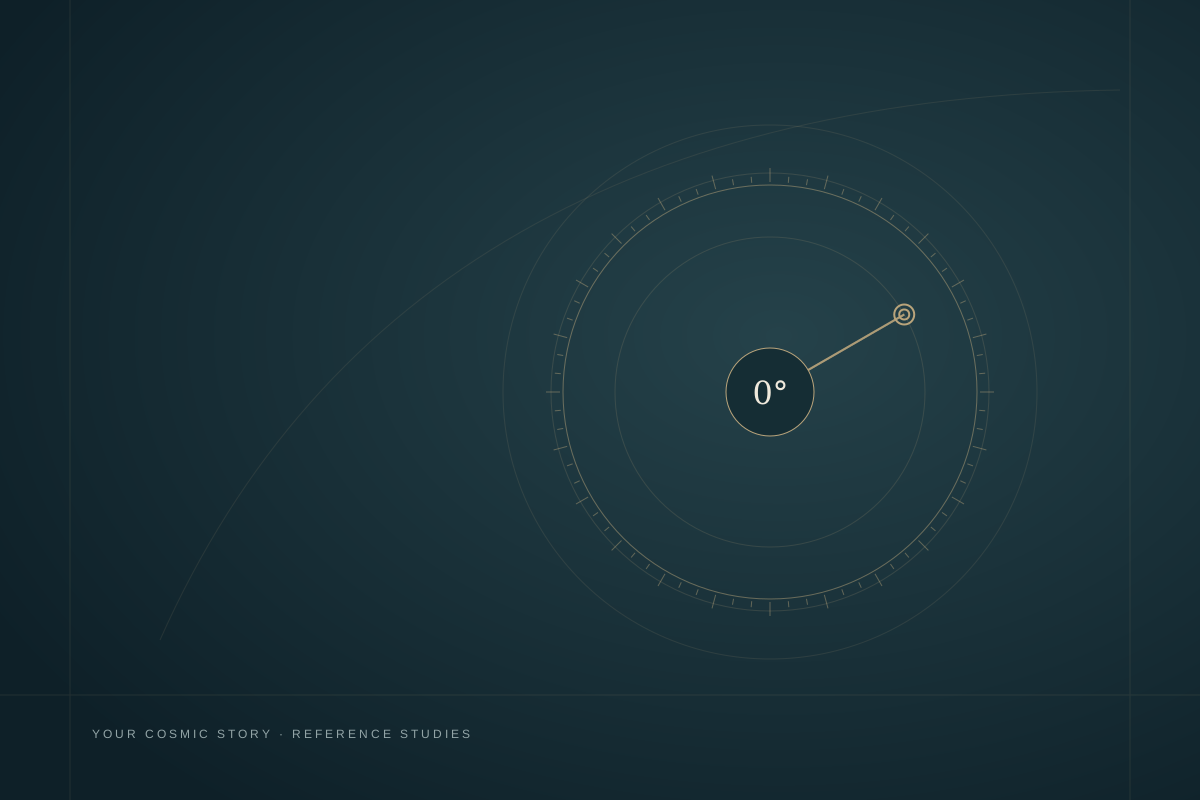
A conjunction is an aspect centred on 0° of separation in ecliptic longitude. In a degree-based reading, two positions qualify when their shorter longitude separation falls within the chosen orb.
These entries use a degree-based convention. Compare all five in the aspect reference, or start with the beginner’s guide.
The angle, made visible
INVENTED POSITIONS · NOT A PERSONAL CHART
- A
- 29° Aries · 29° longitude
- B
- 1° Taurus · 31° longitude
- Separation
- 2°
- Exact target
- 0°
- Orb
- 2°
- Example allowance
- 3° · included
Two invented positions on either side of a sign boundary: 2° apart in longitude, or 2° from an exact conjunction.
What does a conjunction mean?
In Cafe Astrology’s modern interpretation, conjunctions bring planetary themes together. We use that idea as a question about combination, rather than a description of someone’s personality.
Begin by naming the two symbols separately. For an invented Mercury–Venus conjunction, our Mercury entry introduces communication, while Venus introduces relating and value. An original reflection might be: when writing an invitation, how do clarity and consideration work together? That question is useful without treating a chart as evidence of a talent or a problem.
Can a conjunction cross a sign boundary?
Yes, under the degree-based convention used here. In the example, 29° Aries and 1° Taurus are only 2° apart. A rule accepting conjunctions within 3° includes them; a rule accepting only 1° does not. Neither position has to move for the classification to change: only the stated rule changes.
A whole-sign approach treats the sign relationship differently. Deborah Houlding describes historical disagreement about conjunctions across sign boundaries. Keep the degree measurement and the tradition’s judgement in separate notes, rather than quietly substituting one for the other. See degrees and whole signs.
Does 0° mean the same place in the sky?
Not necessarily. Ecliptic longitude supplies one coordinate; ecliptic latitude supplies another. USNO defines these coordinates separately. It also distinguishes conjunction from appulse, the closest apparent approach.
As a geometric example, imagine two points at the same longitude, one at latitude +5° and the other at −5°. Their longitude difference is 0°, but their angular separation on the sky is 10°. This is our coordinate example, not a pair of observed planet positions. The aspect diagram flattens the positions onto a longitude circle, so it cannot show that latitude difference.
Read the combination in context
Write down which planets or points are involved, their actual degrees and the orb setting before considering an interpretation. A shared aspect name is not enough to make a Moon–Saturn example equivalent to a Mercury–Venus example. House and angle claims also need the relevant chart information.
Two positions alone do not tell you whether the conjunction is applying or separating. That requires relative motion. Keep this entry’s static example separate from a transit prediction or a compatibility verdict.
A QUESTION TO TAKE WITH YOU
Try the idea, then check it.
Choose two priorities in an ordinary conversation. What becomes clearer when you name each priority before trying to combine them?
This is an original reflection prompt, not a test of an astrological claim.
Sources & further reading
- Cafe Astrology · modern interpretive themes
- Deborah Houlding · traditional aspect conventions
- US Naval Observatory · coordinate definitions
Interpretive language describes a practice. The numerical examples, diagrams and reflection exercises were created for this entry; they are not observed charts or evidence of astrological effects. See our approach to astrology.