What is a square?
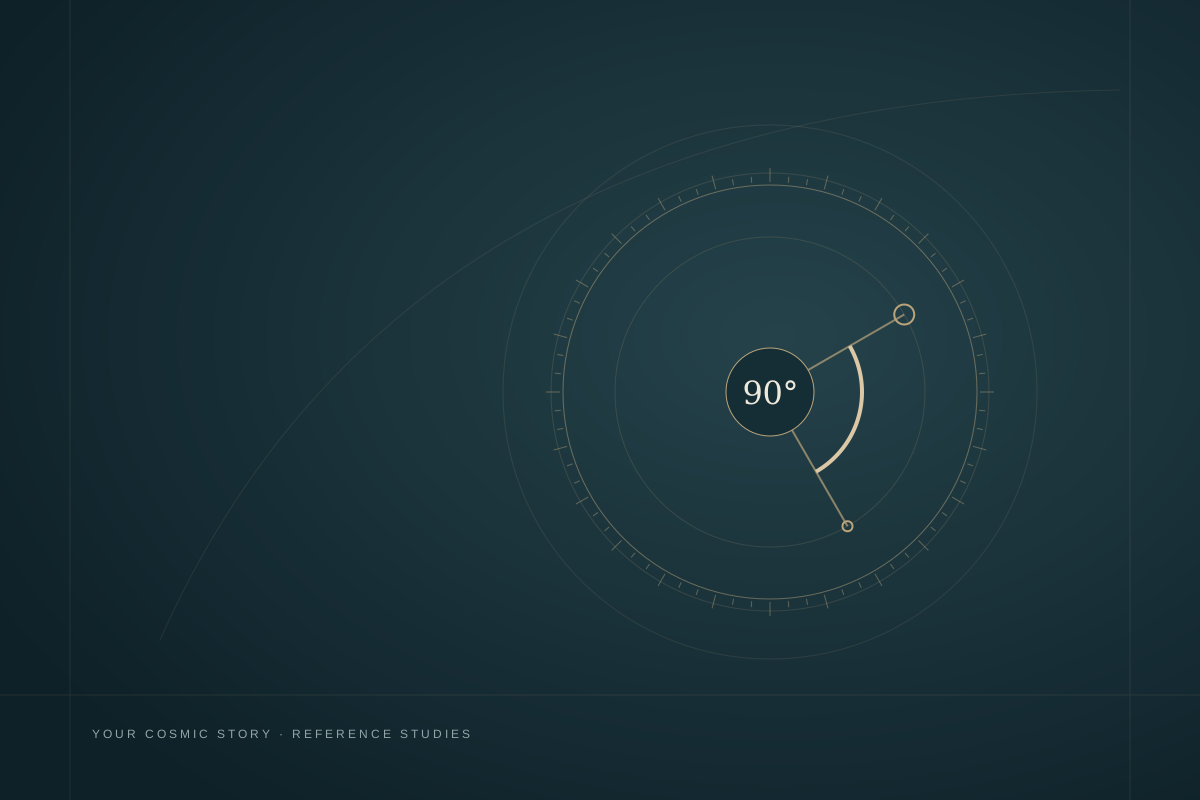
A square is an aspect centred on a 90° difference in ecliptic longitude. In a degree-based reading, the measured separation must be close enough to 90° to satisfy the chosen orb.
These entries use a degree-based convention. Compare all five in the aspect reference, or start with the beginner’s guide.
The angle, made visible
INVENTED POSITIONS · NOT A PERSONAL CHART
- A
- 16° Taurus · 46° longitude
- B
- 15° Leo · 135° longitude
- Separation
- 89°
- Exact target
- 90°
- Orb
- 1°
- Example allowance
- 2° · included
Two invented positions 89° apart: 1° short of the exact 90° square.
What does a square mean?
Cafe Astrology interprets the square through tension and the impulse to act. Our reading prompt uses adjustment: what needs to change when two priorities are difficult to meet together?
Imagine a Moon–Mars square solely as a reflection exercise. Using Moon themes of care and Mars themes of initiative, consider a day when rest and an unfinished project both need attention. A practical question is how to set a workable pace. The aspect does not diagnose stress, establish a cause, or tell you which priority should win.
A quarter turn, with a stated tolerance
A right angle is one quarter of a circle: 360° ÷ 4 = 90°. From 46° longitude, an exact square lies at 136° in one direction or 316° in the other. Both are 90° away along the shorter arc.
The worked example uses 135°, so the separation is 135° − 46° = 89°. Its deviation from the exact square is |89° − 90°| = 1°. It falls within the example’s 2° allowance. A stricter allowance of 0.5° would exclude it.
Notice the distinction between the separation, 89°, and the orb, 1°. Entering 89° as an orb would describe a completely different rule. Keeping both numbers visible makes a chart reading easier to check.
Square and opposition: adjustment or two poles?
A square joins positions near 90°; an opposition joins positions near 180°. On a longitude wheel, the square forms a right angle at the centre, while the opposition stretches across a diameter.
Our square exercise asks what arrangement could help two priorities coexist. Our opposition exercise asks how the situation looks from each of two positions. A schedule conflict can be examined through either question, so the reflection itself is not a test that identifies an aspect. The degrees determine the geometric classification.
Is a square always bad?
A measured angle cannot establish whether an experience is good or bad. Start with the actual question, read the planetary symbols in context and avoid turning a single label into a verdict about a person.
It is also useful to record what a reading leaves unknown. The two longitudes in this example do not establish houses, a life event, or whether the aspect is moving towards exactness. For the last question you need relative motion; see the beginner’s aspect guide.
A QUESTION TO TAKE WITH YOU
Try the idea, then check it.
Think of two current priorities that compete for time. What concrete change could give each some room, and how would you know that change helped?
This is an original reflection prompt, not a test of an astrological claim.
Sources & further reading
Interpretive language describes a practice. The numerical examples, diagrams and reflection exercises were created for this entry; they are not observed charts or evidence of astrological effects. See our approach to astrology.