What is a sextile?
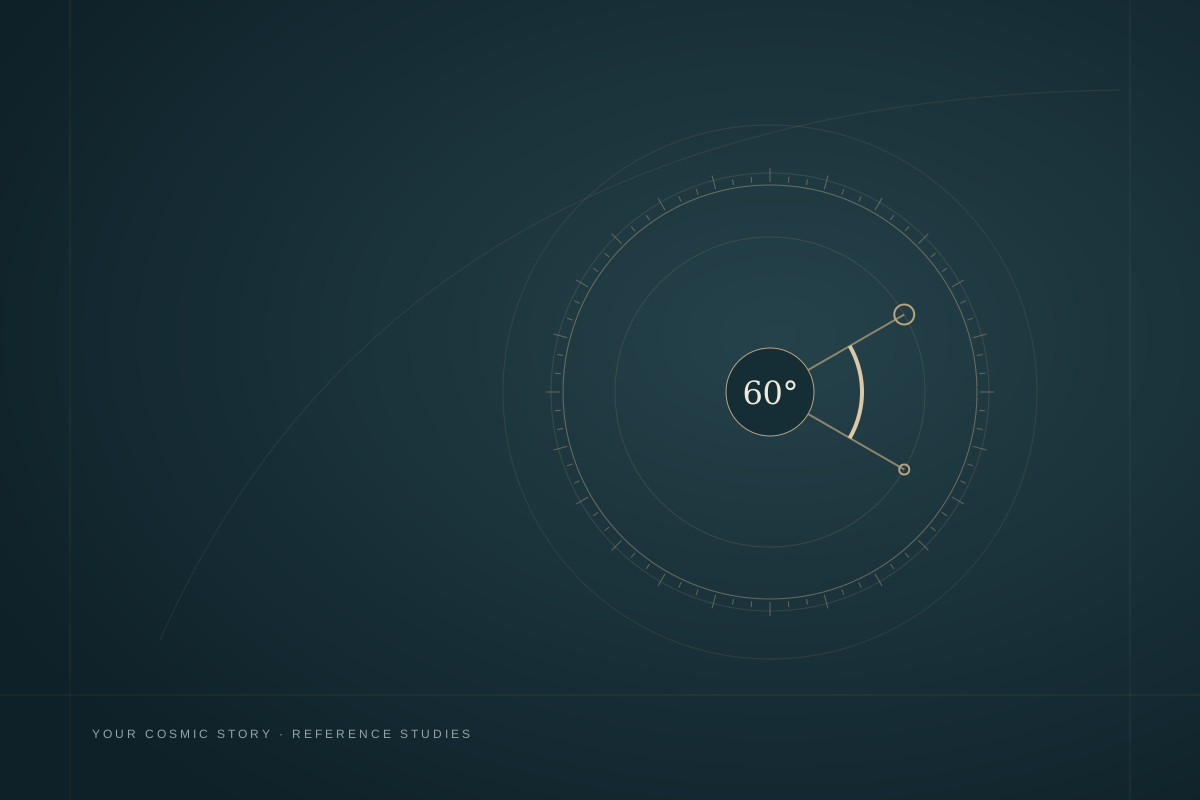
A sextile is an aspect centred on a 60° difference in ecliptic longitude. A degree-based reading compares the measured separation with 60° and accepts it only within the chosen orb.
These entries use a degree-based convention. Compare all five in the aspect reference, or start with the beginner’s guide.
The angle, made visible
INVENTED POSITIONS · NOT A PERSONAL CHART
- A
- 12° Aries · 12° longitude
- B
- 14° Gemini · 74° longitude
- Separation
- 62°
- Exact target
- 60°
- Orb
- 2°
- Example allowance
- 3° · included
Two invented positions 62° apart: the measured separation is 2° wider than the exact 60° sextile.
What does a sextile mean?
Cafe Astrology presents the sextile as cooperation that can be consciously developed. We turn that interpretive theme into an invitation to explore how two activities might support each other.
For an invented Venus–Mars example, take relating and initiative as the two themes, following our Venus and Mars entries. Planning a shared outing gives a simple reflection exercise: one question concerns what people would enjoy; another concerns who makes the first arrangement. This is a reflection we have constructed, not a finding about people with that aspect.
One sixth of a circle
An exact sextile spans 60° because a full circle divided into six equal arcs gives 360° ÷ 6 = 60°. Starting at 12° longitude, exact sextile positions lie at 72° or 312°. Both have the same shorter separation from the starting point.
The worked example uses 74°, not 72°, so its separation is 62°. Subtract the target angle: |62° − 60°| = 2°. Under an illustrative 3° allowance it qualifies; under a 1° allowance it does not. The 3° setting is an example, not a recommended universal orb.
The direction around the circle does not change this static aspect name. It also does not by itself establish whether moving planets are approaching or leaving exactness.
Sextile and trine: what is different?
The measurable difference is the target angle: a sextile is 60°, while a trine is 120°. Do not identify either from a general impression of harmony.
For reflection, our sextile prompt asks what collaboration you could deliberately try. Our trine prompt asks what already feels familiar enough to overlook. Those are different questions, even when the same two planetary symbols are involved. Neither prompt establishes that cooperation will be easy or that a particular skill exists.
Use the actual positions
Count degrees before relying on sign labels. A whole-sign relationship describes a different layer: it does not tell you how close two positions are to the exact angle. Keep a note of the chart convention and orb so another reader can reproduce the classification.
If comparing two people’s charts, identify which position belongs to which chart. The same geometry can be present, but it is a cross-chart comparison, not the same interpretive context as a natal chart. No single sextile can establish relationship quality.
A QUESTION TO TAKE WITH YOU
Try the idea, then check it.
Name two activities that could support each other this week. What small, observable experiment would let you try that cooperation?
This is an original reflection prompt, not a test of an astrological claim.
Sources & further reading
Interpretive language describes a practice. The numerical examples, diagrams and reflection exercises were created for this entry; they are not observed charts or evidence of astrological effects. See our approach to astrology.