What is a trine?
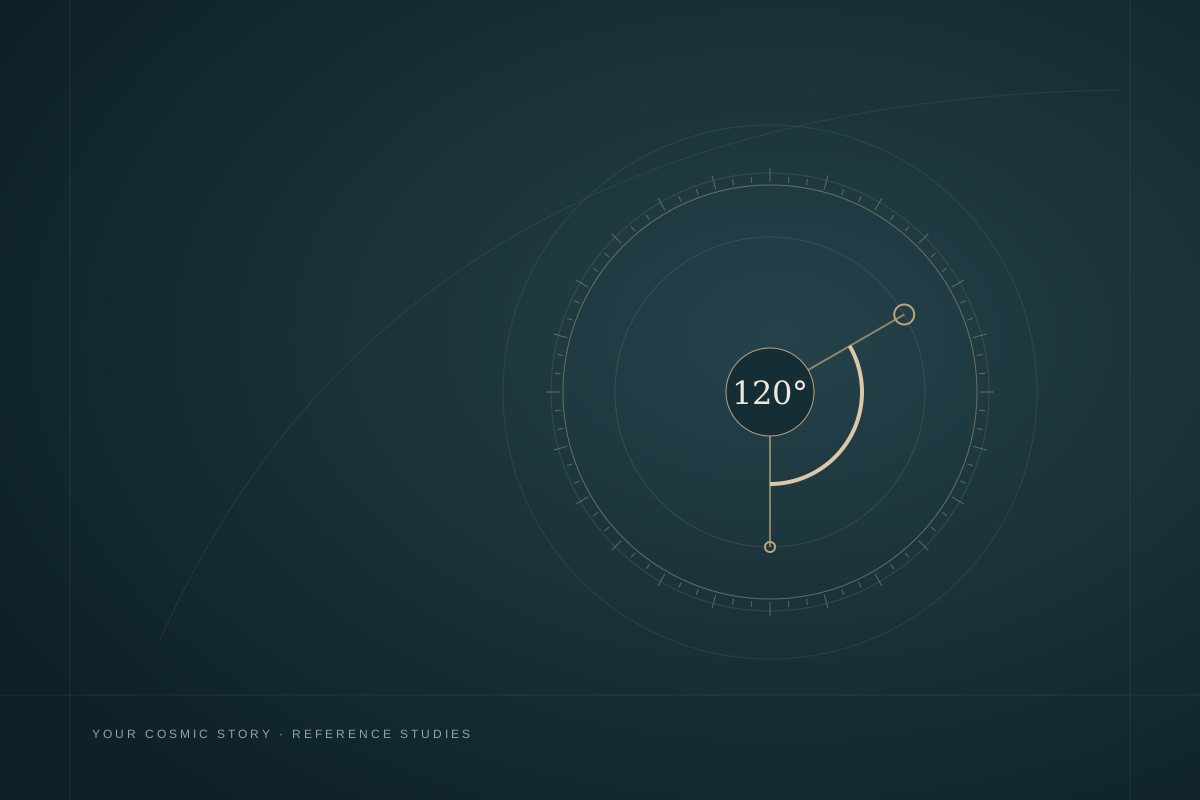
A trine is an aspect centred on a 120° difference in ecliptic longitude. In a degree-based reading, closeness to 120° is measured against an explicitly chosen orb.
These entries use a degree-based convention. Compare all five in the aspect reference, or start with the beginner’s guide.
The angle, made visible
INVENTED POSITIONS · NOT A PERSONAL CHART
- A
- 29° Aries · 29° longitude
- B
- 1° Virgo · 151° longitude
- Separation
- 122°
- Exact target
- 120°
- Orb
- 2°
- Example allowance
- 3° · included
Two invented positions 122° apart: a 2° orb from the exact trine, even though the signs belong to different elements.
What does a trine mean?
Cafe Astrology associates the trine with ease and qualities that feel natural. Our reflection asks what is familiar enough to go unnoticed, without assuming a person has a particular talent.
For an invented Mercury–Jupiter example, take communication and wider understanding from our Mercury and Jupiter entries. An original exercise is to explain a familiar topic to a newcomer. Notice where your explanation is clear and where you skip a step. The listener’s response gives useful feedback; the aspect alone does not tell you how well you teach.
One third of a circle
Three equal arcs divide a circle into 120° portions: 360° ÷ 3 = 120°. From 29° longitude, exact trine positions lie at 149° or 269°. Either has a shorter separation of 120° from the starting point.
In the worked example, the second position is 151°. The separation is 151° − 29° = 122°, making the deviation |122° − 120°| = 2°. The example’s 3° allowance includes it; a 1° allowance does not. Changing the allowance changes inclusion, not the underlying positions.
Must a trine connect the same element?
Exact 120° steps connect the same degree within signs of the same element in the twelve-sign scheme. But allowing an orb can move one position across a sign boundary. Our example deliberately makes that distinction visible.
Aries is a fire sign and Virgo an earth sign. The example’s 29° Aries and 1° Virgo are nevertheless 122° apart. They qualify as a trine under the stated degree rule while not forming a whole-sign trine. A reader using a different tradition may treat that combination differently; state the convention instead of hiding the discrepancy.
Trine and sextile: use a different question
A sextile has a 60° target, half the trine’s 120°. Our sextile exercise asks what cooperation you could try deliberately. Here, the question is what you already do with little conscious attention.
Familiarity is not the same as benefit. An easy routine may be useful, neutral or worth changing. Check the real situation and the feedback you receive before adopting any interpretation. Nor does a single trine establish a three-point configuration: that would require additional positions and additional measured relationships.
A QUESTION TO TAKE WITH YOU
Try the idea, then check it.
Choose something you do almost automatically. How would you explain its steps to a beginner, and which step might deserve more attention?
This is an original reflection prompt, not a test of an astrological claim.
Sources & further reading
Interpretive language describes a practice. The numerical examples, diagrams and reflection exercises were created for this entry; they are not observed charts or evidence of astrological effects. See our approach to astrology.