The short answer
A stellium is a concentration of planets in a sign or house under a stated astrological definition. Authors differ about the minimum count, eligible bodies and whether close conjunctions are required.
Does a stellium need three planets or four?
CHANI's glossary uses three or more planets in one sign or house. Donna Cunningham's The Stellium Handbook, printed page 14, uses four or more and adds a condition about which planets participate. Chris Brennan and Patrick Watson's episode on stelliums explicitly discusses the disagreement over counts and eligible objects.
There is therefore no single threshold that this page can label as the universally correct one. A useful report should tell you the rule it applies. “Four planets in Gemini under a same-sign rule” communicates more than an unexplained stellium badge.
The examples below use simple, explicitly chosen counting rules so that you can inspect the reasoning. They are original schematic positions, not actual birth charts or a proposed universal detection standard.
Same sign does not mean the same distance apart
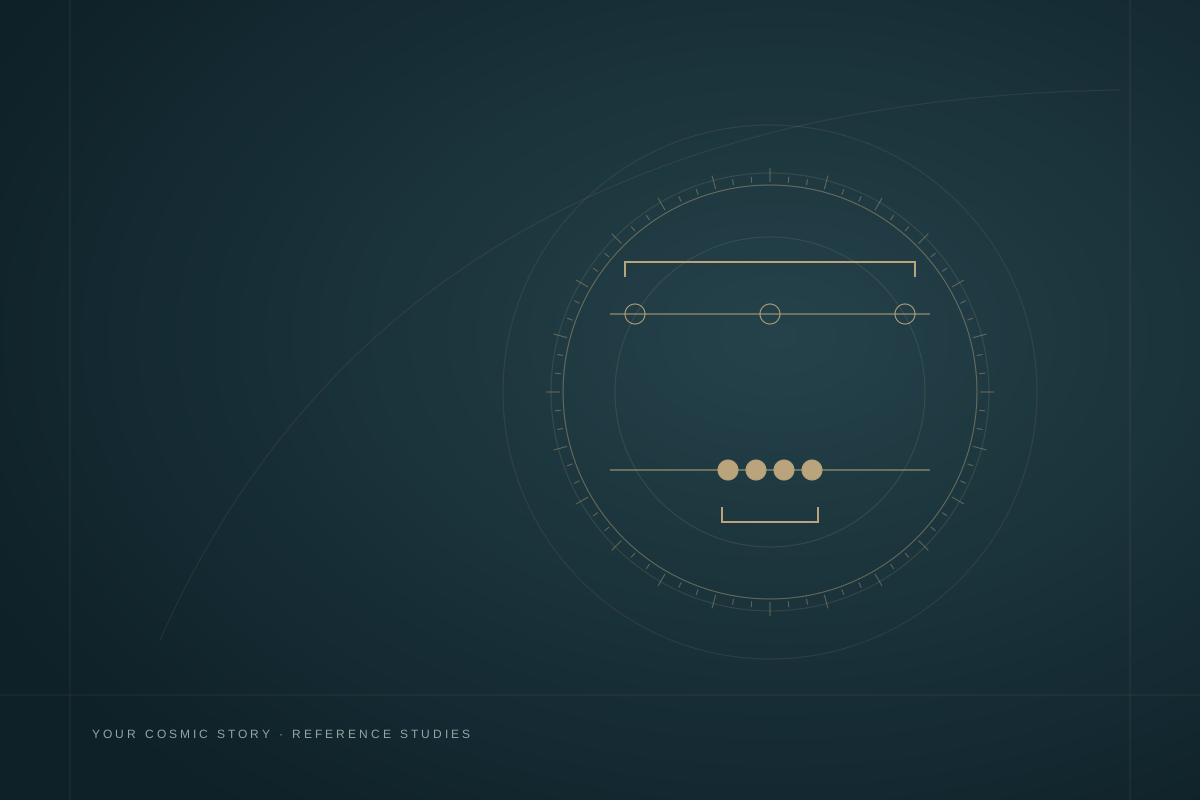
In example A, three eligible placements lie at 2°, 15° and 28° Aries. All are in one sign. The span from the first to the last is 26°, and adjacent gaps are 13°. It meets a three-body same-sign rule but not a four-body rule.
In example B, four eligible placements lie at 10°, 12°, 15° and 17° Aries. The overall span is 7°. It meets both the three-body and four-body count thresholds for a same-sign grouping, provided the objects satisfy the selected eligibility rules.
Now add a separate, hypothetical conjunction allowance of 8°. Every pair in B falls within that allowance; no pair in A does. We chose 8° only to demonstrate the difference between a counting test and an angular test. It is not a recommended default, and satisfying these simple tests does not establish that Cunningham's complete definition has been met.
A sign stellium and a house stellium ask different questions
A sign groups zodiac longitudes. A house groups positions under a house-division method. In Whole Sign houses, each complete sign supplies one house, so those boundaries align. With other systems, a house may span parts of more than one sign.
Consider a purely schematic house interval from 20° Aries to 20° Taurus. Placements at 25° Aries, 2° Taurus and 10° Taurus all lie in that interval, but they do not all occupy one sign. Conversely, a boundary through the middle of Aries could place the three points in example A into different houses.
Neither case means the planets moved when you changed the grouping. The question changed. Record “same sign,” “same house” or “close conjunctions” explicitly. See the house-system comparison for the boundaries behind a house label.
Do the Sun, Moon, nodes and angles count?
Astrological writing commonly includes the Sun and Moon in its planetary vocabulary, but a stellium method still needs a declared object list. Cunningham's rule has additional selection requirements; a simple three-body count is a different convention.
For your own comparison, copy the exact list used by the report. Does it include only the Sun, Moon and planets through Pluto? Are asteroids, the lunar nodes or angles counted too? Adding more eligible objects can change a result without changing any coordinate.
A useful worksheet has four fields: minimum count, eligible objects, grouping rule and any angular allowance. Leave a field marked unknown if the report does not provide it. That makes the missing information visible instead of encouraging you to infer a rule from the result you prefer.
Read a concentration without making it the whole chart
Begin by naming the participating planets individually. A shared location is a reason to examine their relationship, not to erase their different symbolic roles. The planet reference can help you keep that vocabulary separate.
An original exercise is to make one sentence for each participating planet using the same sign or house setting. Then look for the repeated question. You might notice that several sentences concern how you approach a shared responsibility, but they need not suggest the same preference or action.
Next, inspect the actual separations and any relevant conjunctions. Follow the ruler of the occupied sign if that belongs to the method you are studying. Finally, return to the rest of the chart. A concentration does not make every other placement irrelevant.
Keep any personal observation in a separate column from the symbolism. This helps you notice when a compelling label adds little to what you already know, or when a practical question proves more useful than a general description.
Birth time and rarity claims need their own checks
A house grouping requires supported house boundaries. Without a birth time, a displayed house stellium may be an artefact of an assumed time. A same-sign grouping can also require checking the range of a time-sensitive placement, particularly the Moon or a body near a sign boundary.
Calling a configuration rare requires more than identifying it in one chart. A frequency statement needs a defined time sample, location assumptions where houses are involved, an eligible object set and the exact counting rule. We do not infer rarity from either schematic example.
When comparing reports, change one setting at a time and keep the coordinates beside the result. The shortest useful explanation may simply be “these tools use different definitions.” Continue with empty houses to explore the complementary question of how positions are distributed across the rest of a chart.
A question to take with you
If two reports disagree about a stellium, which rule would you compare before comparing their interpretations?
Sources & further reading
- CHANI · Astrological key terms
A three-or-more definition of stellium, grouped by sign or house.
- Donna Cunningham · The Stellium Handbook, Part One (PDF)
Printed page 14 gives her four-or-more definition and an additional body-selection condition. Our simple geometry examples are not a full implementation of her method.
- Chris Brennan & Patrick Watson · Stelliums in astrology
Episode 311’s accessible introduction identifies the debate over counts, objects and sign/house grouping.
- CHANI · Working without a birth time
Limits on angles, houses and time-sensitive positions when the birth time is unknown.
These sources distinguish astronomical definitions from named astrological conventions. The worked positions, counting models and exercises are original teaching material. Interpretations are reflective prompts, not established predictions. Read our approach to astrology.