What does Moon in Taurus mean?
A Taurus Moon, also called Moon in Taurus, means that the Moon occupies Taurus in the zodiac used for your birth chart. In Western astrology, this placement brings lunar themes of needs and familiar responses together with Taurus symbolism of continuity and tangible comfort. The Moon is traditionally exalted in Taurus, a dignity that belongs to the placement rather than a measure of anyone’s emotional wellbeing.
A Taurus Moon is also different from the Moon passing through Taurus today. This guide concerns a natal placement that has already been established. It does not calculate your Moon sign.
Start with the placement, then the interpretation
Read the label on your chart before reading its meaning. Which zodiac does the report use? Is the Moon’s sign certain across the possible birth-time range? Does the report give a degree, a house and aspects, or only a sign?
These questions prevent a familiar description from becoming a substitute for missing information. Recognising yourself in a passage cannot verify a birth time. If the input is uncertain, begin with the unknown-birth-time guide.
In the tropical teaching examples below, Taurus covers longitudes from 30° up to, but not including, 60°. A Moon at 42° is therefore at 12° Taurus. This is a supplied coordinate, not a calculated result for a person.
Moon, Sun or Rising in Taurus?
The sign name can be the same while the object or point changes.
| Label | What is in Taurus? | What to establish first |
|---|---|---|
| Moon in Taurus | The Moon | Its zodiac position and the uncertainty in the birth information. |
| Sun in Taurus | The Sun | The Sun’s position; this does not establish the Moon’s sign. |
| Taurus Rising | The Ascendant | The rising point calculated from time, location and the selected framework. |
Our Sun, Moon and Rising guide introduces their different interpretive roles. A shared sign does not make the three labels interchangeable.
Comfort, continuity and room for change
Cafe Astrology’s contemporary description of Moon in Taurus emphasises familiarity, material comfort and steadiness. These are themes within an astrological interpretation, not measured findings about every person with the placement. We use them as questions rather than guarantees about temperament or relationships.
For an original reflection, imagine that a weekly shared meal has become difficult to organise. You enjoy the familiarity, but the current arrangement leaves one person doing most of the work. What is worth preserving: the exact routine, the time together, or the sense of being cared for? Could changing the arrangement preserve what matters?
You do not need a Taurus Moon to ask those questions. The example demonstrates a way of working with the symbolism: continuity can involve adjustment. Someone’s actual preferences and circumstances remain more informative than an assumed need based on a sign label.
Why is the Moon called exalted in Taurus?
In the traditional dignity scheme presented in Deborah Houlding’s adaptation of William Lilly, the Moon rules Cancer and is exalted in Taurus. These are two different assignments. Taurus remains Venus’s domicile; the Moon does not become its sign ruler.
Houlding’s explanation of the dignity table distinguishes a sign-wide exaltation from the specially noted degree. A Moon does not have to occupy that exact degree for the sign-level label to apply in this framework.
Exaltation names a condition within an astrological system. It does not establish an easy childhood, emotional health, wealth or a fortunate life. Use the essential-dignity guide to understand the categories before treating one label as a whole-chart judgment.
Follow Venus, then check the house and aspects
A useful next step is to follow Taurus to its assigned ruler, Venus, and then record where Venus is actually placed. The ruler assignment and the ruler’s placement answer different questions. Our rulership table explains that distinction.
Next, check the Moon’s house if the available inputs support one. Taurus does not automatically mean the second house. A house placement requires the chart’s time, location and chosen house method.
Finally, read an actual aspect from the supplied chart: which other object, what angular separation, and which orb allowance? A sign description cannot supply those missing measurements. If your source only establishes Moon in Taurus, leave the house and aspect fields open.
The same Moon sign can have different phases
The Moon’s phase concerns its relationship to the Sun. Its zodiac sign alone cannot tell you that relationship. NASA’s phase explanation describes how the changing Sun–Earth–Moon arrangement changes the illuminated portion we see.
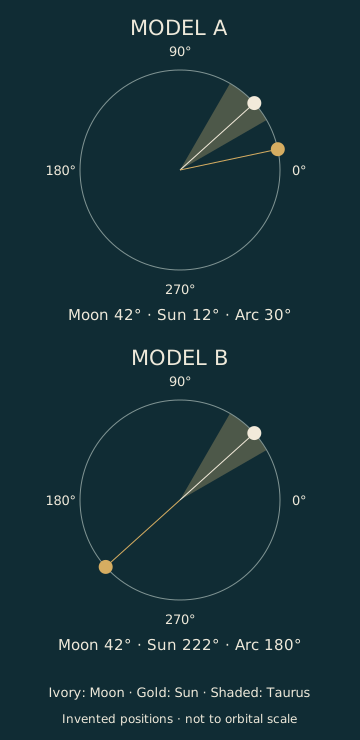
Our simplified longitude exercise uses two invented arrangements in the same tropical zodiac. It does not model orbital distances or lunar latitude, and neither arrangement represents a supplied birth record.
| Model | Moon longitude | Sun longitude | Directed Sun–Moon arc |
|---|---|---|---|
| A | 42°: 12° Taurus | 12°: 12° Aries | (42° − 12°) mod 360° = 30° |
| B | 42°: 12° Taurus | 222°: 12° Scorpio | (42° − 222°) mod 360° = 180° |
Model A falls in the waxing-crescent interval between New Moon and First Quarter in the astronomical vocabulary explained in our phase guide. This is different from Rudhyar’s equal 45-degree astrological sectors. Model B illustrates full-moon longitude geometry. Both keep exactly the same Moon position.
Try it: If all you knew was “Moon at 12° Taurus”, could you choose A or B?
Answer: No. You also need the Sun’s position. The same Moon-sign label leaves the phase undetermined. Likewise, knowing the sign cannot establish a house or every planetary aspect.
What does this mean for compatibility?
A single Moon sign cannot provide a reliable verdict on a relationship. Even within astrological comparison, there are two complete sets of positions to consider. Asking which Moon signs “match” skips much of that information.
If you want to understand the method, begin with synastry basics, then inspect one cross-chart aspect. Keep symbolic interpretation separate from a prediction that a relationship will succeed.
Is this the same as today’s Moon in Taurus?
No. A natal label refers to the Moon at birth. A transit describes a position at another specified time. The moving Moon does not replace your natal Moon’s position. Read transits and the natal chart for that comparison.
Likewise, “Full Moon in Taurus” adds a phase relationship to the sign. A natal Moon in Taurus need not have been a Full Moon, as the exercise shows.
Make a five-line reading note
- Record where the placement came from and which zodiac it uses.
- Write the Moon’s sign and degree only as precisely as the information supports.
- Record the house and house system, or mark them unknown.
- Record one measured aspect and its allowance, or leave the field open.
- Choose one question worth exploring, and note which additional information would help.
The aim is a clearer reading process. For the distinction between personal meaning and demonstrated prediction, continue with astrology and evidence.
Sources and further reading
- Cafe Astrology: Taurus, including Moon in Taurus: selected contemporary symbolic themes. Personal guarantees, bodily claims and stereotypes are not adopted.
- William Lilly, adapted by Deborah Houlding: the Moon: traditional domicile and exaltation assignments. Other historical judgments are outside this guide’s scope.
- Deborah Houlding: reading the dignity table: distinction between sign-wide dignity and a specially noted degree.
- NASA: Moon phases: astronomical phase context, not astrological interpretation.
The hypothetical scene, longitude models and reading note are original teaching material. The linked library guides supply the wider conventions and their source notes.